

A bell tent is a circular canvas shelter held up by one center pole and an A-frame door. Bell tent camping works when you want standing room, a real bed, and a place to sit out rain without living in a nylon tunnel. It does not work as backpacking gear. A typical 5 m (about 16 ft) cotton or polycotton model weighs 40–50 kg (roughly 90–110 lb), needs a car or trailer, and takes a flat pitch big enough for the canvas plus guy lines.
The comfort people expect only shows up if three things are right: the diameter matches how you actually sleep, the fabric has been weathered if it is cotton, and the pitch is taut. Slack canvas, an unseasoned seam, and a hollow under the floor cause more wet nights than “cheap tents” do.
What a bell tent is, and what it is not
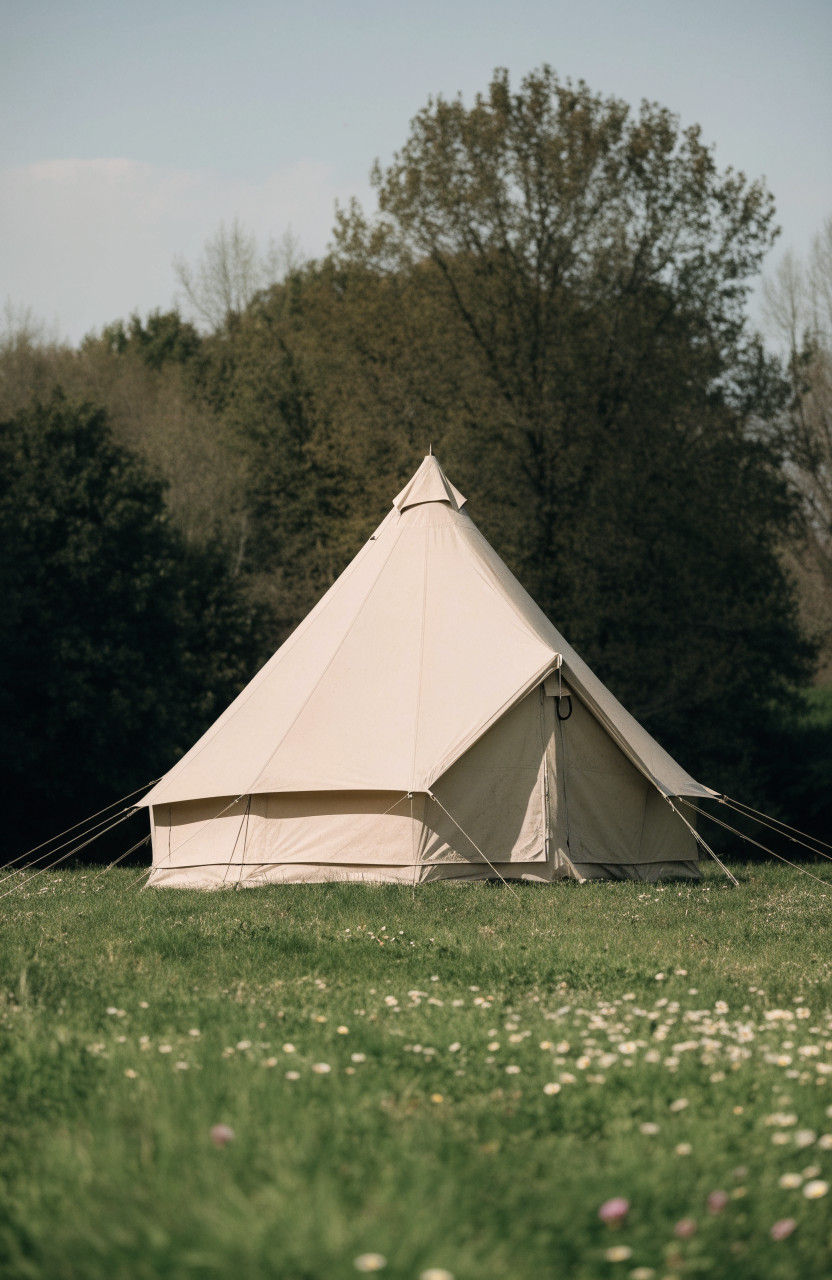
The shape is a cone. Walls are low, often around 90 cm (3 ft), and the roof rises to a single pole that can clear 2.5–3.3 m (8–11 ft) in the middle, depending on diameter. Most modern versions add a zipped groundsheet, mesh windows, roof vents, and sometimes a stove jack.
The design descends from the Sibley tent used by armies in the 19th century. Today it sits between a family tunnel tent and a yurt: faster to pitch than a framed cabin tent, heavier and roomier than a backpacking shelter, and simpler than a multi-pole safari tent.
Two limits are easy to miss in product photos. Standing height exists only near the pole. The outer ring is crawl space, so advertised “sleeps 8” usually means eight bodies on the floor, not eight people with bags, a table, and a dry place to change. And the pole sits in the middle of the floor plan. Beds go around it, not through it.
Who bell tent camping suits
It fits car campers and glamping setups where the tent stays up for several nights, and where someone can carry a heavy bag from the vehicle. Couples who want a real mattress, families who are tired of dividing a tunnel tent into soggy zones, and hosts furnishing a pitch for guests are the usual buyers.
It is a poor match if you hike in, move camp every morning, or camp on sites that ban large footprints and long guy lines. Guy lines on a 5 m tent can push the full footprint toward 7–8 m across. Check the site rules before you buy. Soft sand, rock slabs, and wooden platforms also change the plan: standard pegs fail in sand, and platforms need screws or weights rather than stakes.
Choose diameter by usable floor, not the sleep rating
Bell tents are sold by diameter. Floor area scales with the square of that number, so a 5 m tent is not “a bit bigger” than a 4 m tent. It is substantially larger.
| Diameter | Approx. floor area | Realistic use | Typical packed weight |
|---|---|---|---|
| 3 m (10 ft) | ~7 m² (about 75 sq ft) | One or two people, bags only, little furniture | Often under 25 kg |
| 4 m (13 ft) | ~12.5 m² (about 130 sq ft) | Couple with one bed, or two adults and young children if you travel light | Roughly 30–40 kg |
| 5 m (16 ft) | ~20 m² (about 200–210 sq ft) | Small family, or a couple with a bed plus table and chairs | Often 40–50 kg |
| 6 m (20 ft) | ~28 m² (about 290–300 sq ft) | Larger groups, two beds, or a commercial pitch | Often 50–75 kg |
A 5 m tent is the size most private buyers should start from. A queen bed fits, with room to walk around the pole. A 4 m can take a bed, but the pole and the sloping walls leave little circulation space. A 6 m feels generous and is slower to pitch alone; many makers treat a second person as the practical minimum once the canvas and pole get that tall.
Sleep ratings on budget listings often assume floor space only. If you want cots or a mattress, subtract that footprint and the pole before you trust the number.
Cotton, polycotton, or polyester
The fabric decides how the tent behaves in rain, how it smells after storage, and how much care it needs.
Cotton canvas breathes well. Warm, moist air from breathing and wet clothes can pass through the weave instead of raining back on you. Cotton fibers also swell when wet, which is why a properly seasoned cotton tent sheds rain. The cost is weight, slower drying, and mould if you pack it damp. UV and repeated wet storage wear it faster than a blend.
Polycotton mixes cotton with polyester. It is usually stronger in tear tests, a little lighter, and more resistant to mildew and sun than pure cotton. It breathes less. Many glamping operators prefer it for that durability. It can still weep at needle holes until the cotton portion has been wet and dried.
Polyester “bell-style” tents are the budget end, sometimes half the price of a heavy canvas model. They pitch the same way and can be fully waterproof from day one because they do not rely on fiber swell. They also trap moisture. Condensation is the trade you accept, and cheap groundsheets and pegs are common weak points.
Price tracks size and cloth. In the UK, basic 3–4 m tents often land around £200–£400, a decent 5 m around £400–£700, and large or heavy-canvas models from about £900 upward. In the US, bell-style polyester often sits around $400–$700, while heavier canvas 16 ft models from established makers commonly run about $900–$1,800. A stove jack, zip-in floor, and heavier poles move the price up.
How to pitch a bell tent so it holds
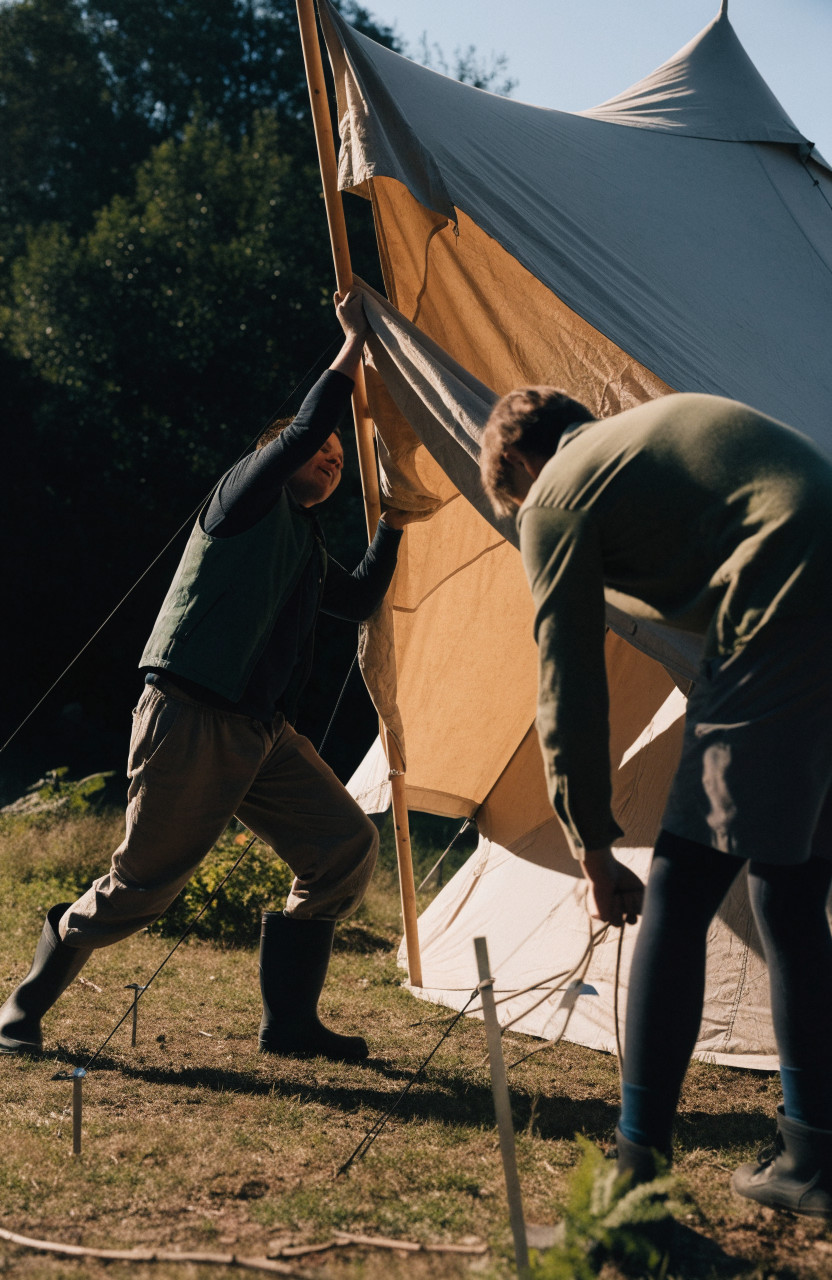
With two people and a previous practice pitch, a 5 m tent commonly goes up in 10–15 minutes. The first time, alone, plan on 30–45 minutes. Do the practice at home. Learning the peg pattern in the dark, in wind, is how door zips get strained.
- Pick the ground before you unpack. Flat, firm, and slightly raised is the target. A hollow under the floor becomes a pond. Clear stones, roots, and cones from a circle larger than the tent. Face the door away from the prevailing wind, and downhill if the site has any slope, so rain is not driven at the entrance.
- Lay the tent out and stake the floor first. Spread it canvas-side as the maker intends, door aimed. Peg the groundsheet loops at the four compass points, pull the floor into a true circle, then fill in the gaps in opposite pairs so tension stays even. A wrinkled floor means the walls will never sit right.
- Raise the pole. Assemble the center pole, step inside, seat it in the roof cone, and lift. A second person outside, taking slack as the canvas rises, stops the pole walking off center. Fit the A-frame in the doorway so the entrance stands open instead of collapsing inward.
- Stake the guys, then tension. Pegs go in at about 45 degrees, leaning away from the tent, typically 60–120 cm (2–4 ft) out from the wall. Tight guylines and a taut eave are what stop rain pooling over the windows. Even tension beats maximum tension. Over-cranking one side pulls the pole off vertical.
- Recheck after the first hour. Canvas and rope relax. Walk the guys again before dark, and again if wind picks up. The usual failure in wind is not the cloth tearing. It is a peg pulling out of soft or wet ground, a skirt lifting, then the whole tent loading the remaining stakes.
Carry spare steel pegs and a rubber mallet. On sand or saturated soil, longer pegs or screw-in anchors matter more than a heavier canvas.
Why new canvas leaks, and how seasoning fixes it
Cotton and many polycotton tents are sewn. Each needle pass leaves a hole slightly larger than the thread. On the first rain those holes can drip, especially along seams. That is normal, not a defective tent.
Seasoning, also called weathering, closes them. Pitch the tent, soak the canvas thoroughly with a hose or sprinkler, and pay extra attention to seams. Let it dry completely. Repeat at least two more wet-dry cycles. Cotton and thread swell, then shrink, and the holes tighten. Some makers suggest a seam sealer only if a spot still drips after that. Do this at home, not on the first wet weekend.
Polyester tents do not season this way. If a polyester bell tent leaks, look at seams, a failed coating, or water coming in through an open vent or a slack eave, not at fiber swell.
Other common “leaks” that are really pitch problems:
- Sagging eaves above windows, so rain runs into the mesh instead of off the roof
- An open or uncovered floor zipper
- A missing or loose rain cap at the peak
- Roof vents facing driving rain
- Water tracking down the center pole after heavy rain hits the top vent
If water beads and runs off, the cloth is doing its job. If it darkens and soaks through across a panel, the proofing is tired and needs re-treatment, or the tent was stored damp and the finish has broken down.
Condensation is not a leak
Warm air from breath, damp clothes, and cooking hits cooler canvas and turns into droplets. You will see this on still, cool nights even in a well-proofed tent. Cotton reduces it compared with nylon. It does not remove it.
Leave roof vents open. Crack a window on the lee side if rain allows. Keep wet kit in the porch or a bag, not piled against the wall. Wipe the lower walls in the morning if they are dripping onto bedding. Cooking inside adds a large pulse of steam. If you do cook under canvas, ventilation stops being optional.
Layout around the center pole

The pole is the constraint every floor plan has to accept. Push the bed against the wall and you lose headroom. Center it and you hit the pole. The workable compromise is a bed offset so sleepers’ heads are near the higher slope, with the pole at the foot or just beside the mattress.
In a 5 m tent, one queen and a small table is comfortable. Two queens are tight. Floor sleepers can ring the pole, but bags belong in the low outer crescent, not in the walking circle. A rug over the groundsheet cuts the cold feel of the floor and catches grit before it works into the zip.
Light wants to hang off the pole or sit on a low crate. Open flame inside a canvas tent is a bad idea. A wood stove belongs only in a tent with a proper stove jack, a heat-resistant mat, stated clearances, a stable flue, and a carbon monoxide alarm. Even then, never sleep with a damper closed down to the point of smouldering, and follow the stove maker’s distances. Canvas near a flue is a fire problem, not a cozy detail.
What to pack beyond the tent
The tent bag should already contain the pole sections, door frame, pegs, and guys. Confirm that before you leave. Add:
- Rubber mallet and a handful of spare pegs, plus longer stakes if the forecast is wet
- Groundsheet protection if the sewn-in floor is thin: a footprint under the tent, not a loose tarp that can pool water and wick inward
- Bedding that insulates. Canvas holds warmth better than nylon once you are out of the wind, but the floor is still ground temperature. A mattress or cot matters more than another blanket on a thin pad
- Lights, a small brush for grass and sand at the door, and a cloth for morning condensation
- For cool nights, dry layers in a stuff sack. Wet clothes left loose are the main condensation source you can control
A separate rainfly is not standard on a bell tent. The canvas is the fly. An awning or porch extension is useful in persistent rain so the door can stay cracked without soaking the floor.
Wind, rain, and cold: realistic limits
A taut, well-pegged bell tent sheds ordinary wind and rain well because the cone has no large flat panel for gusts to push. The limit is the ground. In soft soil the first peg that lifts can unzip the whole pitch. Add guys on the windward side, lower the profile if the maker allows by easing the pole slightly only if instructions say so, and do not leave an unattended tent in a forecast gale on a exposed site.
Heat is the other weakness. Dark canvas in full sun, with vents closed, becomes an oven by late morning. Pitch for afternoon shade if the site allows, without sitting in a drip line under a dead branch. Open every vent. A bell tent is a three-season shelter for most people. Below freezing it works only with serious insulation, a safe heat source, and experience. The low walls and single skin are not a winter cabin.
Drying and storage decide how long it lasts
Mould is the failure mode that ruins more bell tents than storms. Moisture from rain, dew, or overnight condensation, packed into a bag, sits in the fibers. Cotton is especially vulnerable.
Before long-term storage, pitch the tent or hang it until the canvas and the groundsheet are dry on both sides, including seams and the underside of the floor. Sun helps. A damp garage does not. Store loose, off concrete, not compressed in a wet stuff sack. Brush mud off before it dries into the weave. Reproof when water stops beading.
If you buy second-hand, smell the bag. Mildew and a chalky, worn coating are expensive to reverse. A professional clean can also strip proofing, so a cheap used tent sometimes needs a full re-weather and re-treat before it is trustworthy.
Questions people ask after the first wet night
Can one person pitch a bell tent? Yes up to about 5 m, once you know the sequence. The awkward moment is raising the pole while the canvas is still slack. A second person makes the first three pitches much calmer. Larger 6 m tents are a two-person job in any wind.
Do I have to season a polycotton tent? Pure polyester, no. Polycotton, yes if you want the first heavy rain to be uneventful. Dense modern polycotton weaves leak less than old cotton, but needle holes still exist. Two or three hose-and-dry cycles at home are cheap insurance.
Why is the wall wet inside when it did not rain? That is condensation. Vents were closed, wet gear was inside, or several people slept in still air. Wipe it down, open the peak vents the next night, and do not pack the tent until it has aired.
Is a bell tent waterproof in all-day rain? A seasoned, taut canvas tent handles steady rain. It does not handle sagging eaves, an open floor zip, or a roof vent pointed into wind-driven rain. Recheck tension after the canvas gets wet. Wet cloth stretches, and that is when pools form.
Is the center pole removable? On a standard bell tent, no. A few designs use an external tripod or hang the roof from a frame so the floor is clear. Those are different structures. If an unobstructed bed is the priority, look at that layout before you buy a classic single-pole tent and try to work around it.