Four things make a tent feel cozy: level ground, a sleep surface that holds heat, warm low light, and a floor clear enough to move around. Decor helps after those four things are handled. These 20 cozy tent camping ideas are ordered that way: site first, then sleep, light, layout, and the space outside the door.
Most “cozy campsite” lists stop at string lights and throw pillows. Those work, but only if the tent is not pitched in a drainage dip, the mattress is not dumping body heat into the soil, and the extra textiles are not trapping condensation against the walls. Car camping can borrow a lot from home. Backpacking cannot. The notes below flag which ideas travel and which stay in the car.
Start with the site, not the styling
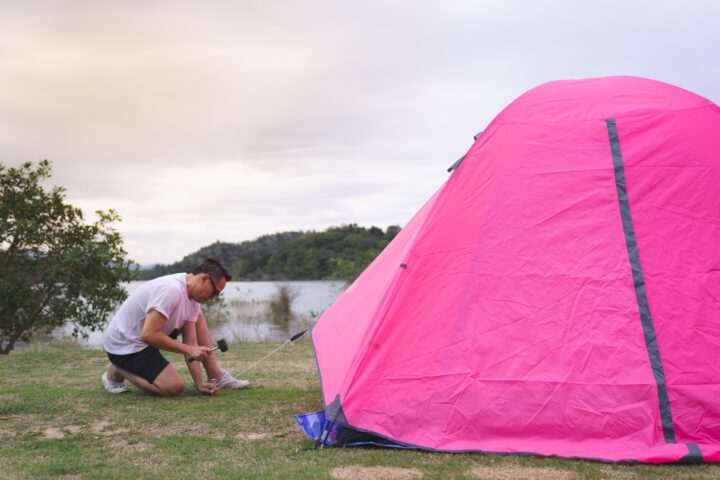
1. Pitch on ground that is flat and slightly raised
A slope rolls you downhill all night. A hollow collects rain. Cozy begins before the tent is staked: walk the pad, lie down if you can, and reject spots that tip your hips or sit in a low line where water would run. Slightly higher ground with a gentle fall away from the door keeps the floor drier than any rug.
2. Point the door at morning sun and away from the prevailing wind
A door that faces east warms the tent earlier and helps damp fabric dry. A door aimed into the wind turns every zipper trip into a blast of cold air and drives rain under the fly. If the campground pad only allows one orientation, use the vestibule or a small tarp as a wind break on the exposed side rather than fighting the layout with more blankets.
3. String a tarp as a porch, not only as emergency rain cover
A tarp pitched high and taut over the entrance gives you a dry standing area for shoes, a chair, and a lantern. That porch is what makes rainy evenings feel contained instead of postponed. Stake it so water sheds away from the tent, and leave a gap at the peak for airflow. A sagging tarp becomes a water bag by midnight.
4. Treat the capacity rating as a maximum, not a plan
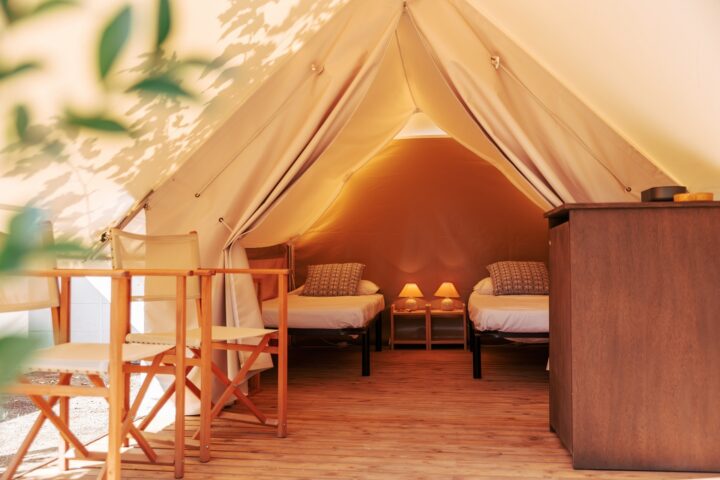
A “four-person” dome is a two-person bedroom once pads, bags, and a bag of clothes are inside. Cozy needs a path from the door to the bed and a place to sit up. For car camping, a cabin-style tent with standing height does more for comfort than any textile, because changing clothes and sorting gear stop being a floor wrestle. Half the stated capacity is a realistic target if anyone will spend time inside after dark.
Build a sleep system that holds heat
5. Get your body off the ground
Cold comes up through the floor faster than it comes through the walls. A camping cot, a thick self-inflating pad, or an insulated air mattress each solves a different problem. A cot lifts you off damp nylon and creates storage underneath, which matters in a small tent. A thick pad is simpler and warmer if you choose one with real insulation. Household guest beds are the weak option: they feel plush and still sleep cold.
6. Put closed-cell foam under any plain air mattress
An ordinary air mattress is a chamber of moving air. Cold ground chills the bottom of that air, the air circulates, and the surface becomes a cooling pad. Sleeping pads are rated with an R-value under ASTM F3340, so the numbers can be compared. Roughly, R 1–2 suits summer nights above about 50°F (10°C), and R 2–4 covers typical three-season use. A plain air bed often has no listed R-value at all. A closed-cell foam pad underneath acts as a thermal break, and R-values of stacked layers add together.
7. Bring real pillows and a quilt if the car is doing the carrying
A camp pillow the size of a paperback is fine on a trail. On a drive-in site, the pillow from your bed is the highest-comfort item that costs nothing extra. Sheets or a quilt over a sleeping bag let you vent heat without climbing out of a mummy hood. Pack them in a dry bag or bin so a wet trunk does not undo the point.
8. Choose a bag or quilt you can layer, not a sack you cannot escape
Narrow mummy bags save weight and feel restrictive once the evening is mild. A rectangular bag, a camping quilt, or a bag you can unzip into a blanket matches how people actually sleep: warmer at 2 a.m. than at 10 p.m. Check the comfort rating, not only the lower limit printed in the name. A bag rated in a lab assumes a pad with meaningful insulation underneath. On a bare air bed, it will sleep colder than that number suggests.
9. Change into dry sleep clothes before you get in
Sweat from the hike or the fire cools fast once you stop moving. A dry base layer and dry socks do more for the first hour in the bag than another decorative blanket. Keep that set in a stuff sack at the head of the bed so it stays dry even if the vestibule is wet.
Sealing the tent to keep warmth in backfires, because warm breath condenses on cold fabric, and blankets piled against the walls make it worse. Leave vents cracked even on cool nights, and wipe the walls down in the morning on humid trips.
Use warm light, and keep flame outside
10. Hang short runs of battery LED lights, then dim them
A single strand of warm-white LEDs along the ridge or around the ceiling loop changes the tent from a work light into a room. Battery packs beat outlet strings at a campground that may not have power, and they avoid cords across the floor. Short runs are enough. A tent wrapped in lights is harder to sleep in and burns through batteries by the second night. Look for sets rated for outdoor use if any of the strand will sit near a door or vestibule.
11. Split task light and mood light
One lantern at the peak, or a headlamp on a low shelf, is for finding a zipper and a water bottle. A second, dimmer source is for reading. Mixing those jobs is why people end up with a harsh beam in their eyes. A paper or fabric shade over an LED lantern softens the pool of light without adding candle risk. Metal lantern housings handle wind better than paper if you move the light outside.
12. Keep every open flame out of a nylon or polyester tent
Tent fabrics and sleeping bags melt or ignite faster than living-room textiles. Battery candles and LEDs give the flicker without the failure mode. If a campground allows a fire, keep it in the ring, downwind of the door, and fully out before sleep. Lanterns with real fuel belong on a stable surface outside the fly, not on a pad next to a quilt.
13. Add a small night light you can find without sitting up
A button light or lantern with a long runtime, hung where your hand already goes, stops the 2 a.m. headlamp blast that wakes everyone else. Children and anyone who wakes often get more from this than from another strand of decorative lights.
Cooking inside a standard camping tent loads the air with steam, and stoves add carbon monoxide and fire risk. Use the vestibule only if the manufacturer allows it and the space is open to outside air; in bad weather, a tarp porch makes the better kitchen.
Make the inside feel like a small room
14. Cover the floor, but do not extend any layer past the tent
A camp rug, foam tiles, or a folded fleece softens cold nylon and defines a place to stand. The ground cloth under the tent should stop at or inside the floor edge. Fabric that sticks out past the fly catches rain and funnels it underneath. Inside, leave a border of bare floor near the door so wet shoes never reach the rug. A rubber-backed bath mat in the vestibule is the simplest version of that border.
15. Store upward so the floor stays walkable
Clutter is what makes a tent feel temporary. Hanging pockets, a short line of cord along a seam, and a bin or crate under a cot put clothes and food off the ground. In a small tent, two stackable bins beat a scatter of stuff sacks. Clear floor reads as space even when the square footage has not changed.
16. Put a stable surface at the head of the bed
A folding side table, a small crate, or the lid of a bin holds water, glasses, and the night light. Reaching across a dark tent for those items is how drinks spill onto bags. Keep the surface low and away from the wall so it does not press fabric into the rain fly and create a wet spot.
17. Separate sleep from gear
Boots, the cook kit, and the rain jacket belong in the vestibule or a bin by the door, not at the foot of the bed. A simple rule helps: anything that can be wet or sandy stops at the threshold. The bed zone stays for sleep layers only. That split matters more in a two-person tent than in a bell tent with room for chairs.
Extend the cozy zone outside the door
18. Build a lounge that is not the bed
If the only soft seat is the sleeping pad, the tent becomes a place you crawl into and stay. Two camp chairs, or one chair and a folded blanket on a closed-cell pad, give the evening somewhere to happen. Inflatable couches work for car camping and are a poor idea if you have to carry them. Place the seats where smoke from the fire ring will not sit in the fabric all night.
19. Define the sitting area with one rug and a low table
An outdoor rug under the chairs, kept small enough to shake out, makes a loose cluster of seats feel intentional. A low table or tray keeps cups off the ground and off the tent floor. Skip large canvas rugs if the forecast is wet. They hold water, smell by morning, and are slow to dry before you pack.
20. Close the day with a short, repeatable routine
Cozy is also a sequence. Shoes off at the mat, lantern to the low setting, water at the bedside, fire or stove fully out, rain fly checked. The same order every night means you are not hunting for a headlamp in the rain. It costs nothing and does more for how the tent feels at bedtime than another pillow.
What to prioritize by trip type
| Priority | Car camping or base camp | Backpacking or bike touring |
|---|---|---|
| Sleep | Cot or thick insulated pad, home pillow, quilt | Pad with an R-value matched to the night, compressible pillow |
| Light | Short warm LED strand plus one lantern | Headlamp with a low red or warm mode |
| Floor | Small outdoor rug and vestibule mat | Thin foam sit pad used as a doormat |
| Outside | Chairs, tarp porch, low table | Tarp only if weather or bugs justify the weight |
| Skip | Household air bed with no foam under it, open-flame candles, oversized rugs | Anything that only works if the car is 20 feet away |
Frequently asked questions
Do I need a special glamping tent?
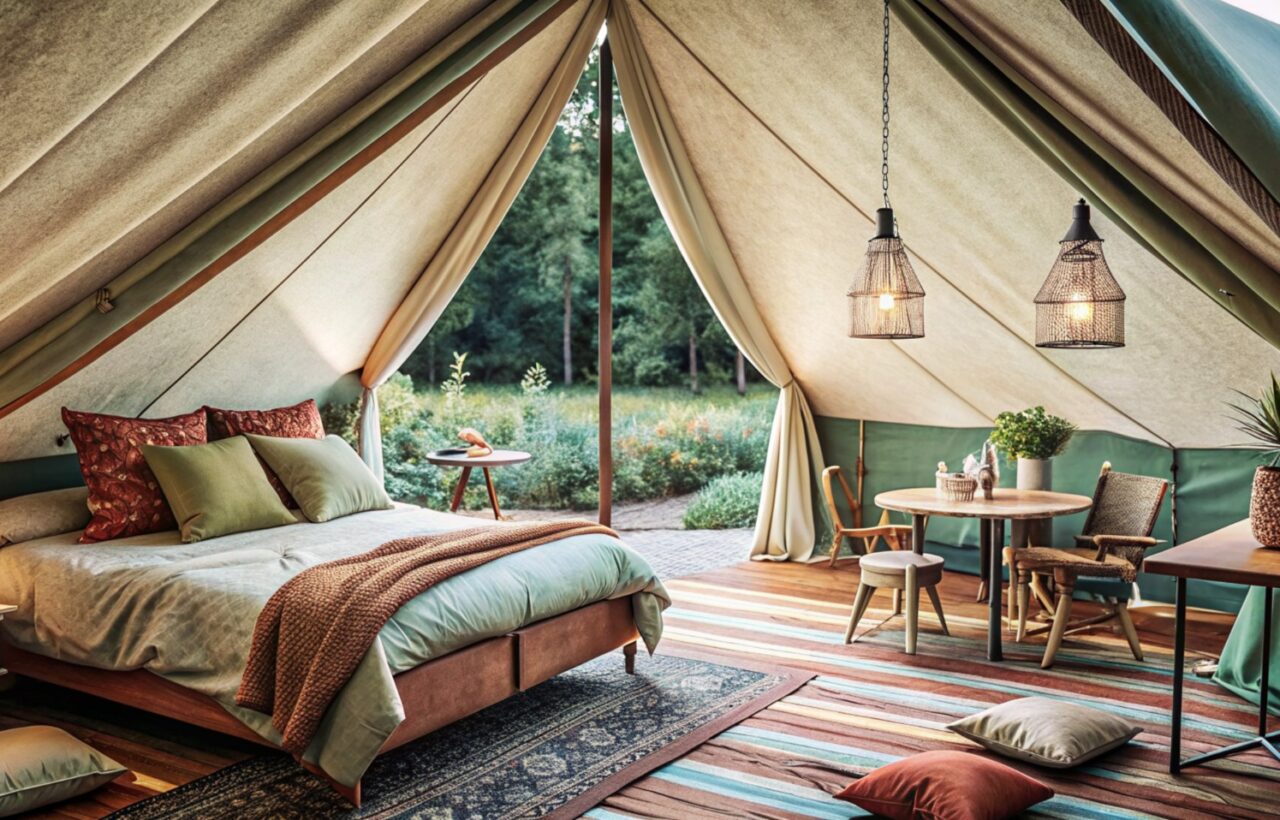
No. A tent you can sit up in, a pad that insulates, dry bedding, and warm battery light cover most of the difference people mean by cozy. Canvas bell tents and standing-height cabins add space and breathability. They also weigh more, take longer to dry, and can mold if stored wet. Use them when the car can carry them and the site allows the footprint.
Are fairy lights safe in a tent?
Battery LED strands on a cool-running set are the usual choice. Do not use mains-powered indoor strings, damaged wires, or anything that gets hot. Keep connections off the floor, and do not run lights all night if sleep is the goal. Open flame, including real candles in decorative lanterns, does not belong in a nylon tent.
How do I keep a tent cozy in the rain?
Pitch out of drainage lines, use a footprint that does not stick out, add a taut tarp porch, and stage dry clothes before the rain starts. Inside, a vestibule mat and shoes-off rule protect the rug and the bag. Ventilation still matters. A fully sealed tent in rain becomes a damp tent by morning.
What is the single highest-impact upgrade?
For most car campers, it is the sleep surface: an insulated pad, or foam under an air mattress, plus a real pillow. Lights and rugs change the look. Ground insulation changes whether you sleep.