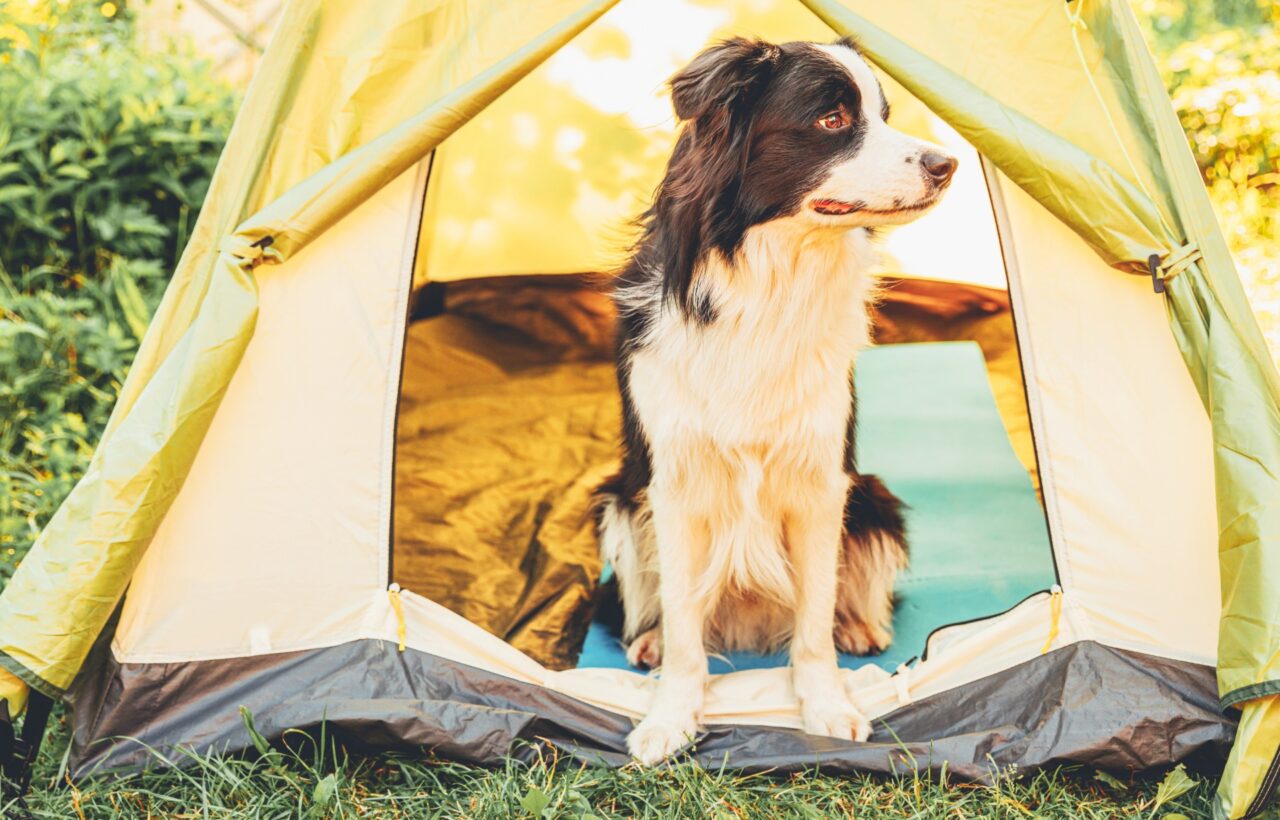

Many owners prepare for tent camping with dogs by shopping for gear, yet trips rarely end early because of a sleeping pad. They end because a national park bans dogs on its trails, a dog tied outside barks through the night, waste gets left near camp, or heat and hot ground prove too much.
A more useful approach starts with the land. Developed campgrounds and dispersed forest sites set different rules, so confirm what applies where you plan to walk. Then build the tent setup, leash routine and bathroom plan around that rule, ideally with a dog already comfortable inside a tent.
Building a packing list with your dog? Add a dog in the checklist generator and it includes food for every day, extra water, bedding and vaccination records.
Decide whether this dog and this trip match
Age and enthusiasm are poor predictors. A fit adult dog that settles at home can do fine. A high-drive dog that has never been in a tent, or a senior with joint pain, often cannot. Puppies can sleep in a tent, but long or steep approaches should wait until growth plates are finished: roughly 6 to 8 months for small dogs, about 12 months for medium dogs, and 12 to 24 months for large and giant breeds. Ask your veterinarian before a hard trip if the dog is brachycephalic (flat-faced), senior, overweight, on medication, or has a history of heat intolerance or heart disease.
Before you book, the dog should already tolerate these things at home:
- Entering and lying down in a pitched tent without panic
- A harness they cannot back out of (collars slip when a dog pulls backward)
- Sleeping on a pad instead of the bare floor
- Being handled in the dark for a bathroom break
- Staying quiet when people and other dogs pass
A backyard overnight is the useful test. If the dog paces, barks at every sound, or tries to shred the door, a campground will be worse, not better. Bring the same bed, blanket, and food. Novelty is what wakes dogs at 2 a.m.
Vaccinations should be current. Many campgrounds ask for a rabies certificate. Flea, tick, and heartworm prevention should match the region and season, because raccoons, rodents, and ticks are common around camps. A microchip with current contact details, plus a readable ID tag, matters more in the woods than at home: a startled dog can cover a lot of ground before you notice the leash is empty.
Match the land type to what you actually want to do
“Dog-friendly campground” does not mean “dog-friendly trails.” That mismatch is the most common reason a booked trip falls apart.
On National Park Service land, pets must be crated, caged, or on a leash no longer than 6 feet, and they may not be left unattended and tied to an object except where a superintendent allows it. Noise that disturbs other visitors or wildlife is also prohibited. In practice, many parks limit dogs to roads, parking areas, and campgrounds. Yellowstone and Glacier are especially strict: trails and backcountry are closed to pets. A campground reservation inside the park does not unlock the hikes.
National forests and Bureau of Land Management sites are usually more open. In developed recreation areas the leash is still typically 6 feet, and some forests ask that you not bring more than two dogs to a site and that dogs stay inside a tent, vehicle, or kennel at night. Outside developed areas, “under control” rules vary by forest order and state law. Private campgrounds often add pet fees, breed or weight limits, and quiet hours with real enforcement.
Before you pay, confirm three things with the managing agency or the campground, not a third-party listing:
- Are dogs allowed on the trails you plan to walk, or only at the site?
- Is there a pet fee, a number limit, or a breed or weight restriction?
- Where should the dog toilet, and where does waste go?
If the point of the trip is hiking, a national forest or state park with open trails is usually a better fit than a flagship national park. If the point is a first overnight, a private or state campground with short loops and nearby help is the lower-risk choice.
What to pack, and what each item is preventing
Pack the dog’s normal food for the whole stay plus two extra days. Activity and cooler nights raise calorie needs; a sudden diet change raises the chance of diarrhea in a tent. Water needs rise with heat and exercise. A common veterinary planning figure is about 1 ounce per pound of body weight per day, increased for work and heat, and natural water is not a substitute. Streams and lakes can carry Giardia and other parasites. Blue-green algae in warm, stagnant water can be fatal if a dog drinks it or licks it off their coat.
Core kit:
- A well-fitted harness and a 6-foot leash, plus a spare leash or slip lead
- A long line only if the site allows it and you are holding it; a stake-out is not a substitute for supervision
- Collapsible bowls, and enough water that you are not rationing
- Waste bags far beyond what a normal walk uses, plus a sealable dry bag
- A closed-cell foam pad or insulated dog pad so the dog is not losing heat into the ground
- Familiar bedding, a towel for wet fur, and a light they can wear after dark
- Any daily medication, and a basic pet first-aid kit: tick remover, tweezers, saline for flushing eyes or wounds, vet wrap, antiseptic wipes, styptic powder for a torn nail, and a copy of vaccination records
- A recent photo on your phone in case the dog is lost
Boots are worth packing for sharp rock, cactus, ice, or hot ground, but only if the dog has already worn them on walks. A first use on a trail usually means boots coming off in the first mile. A reflective vest is useful in hunting season, when a dog in brush can be mistaken for game.
Set the tent up so the night does not become the problem
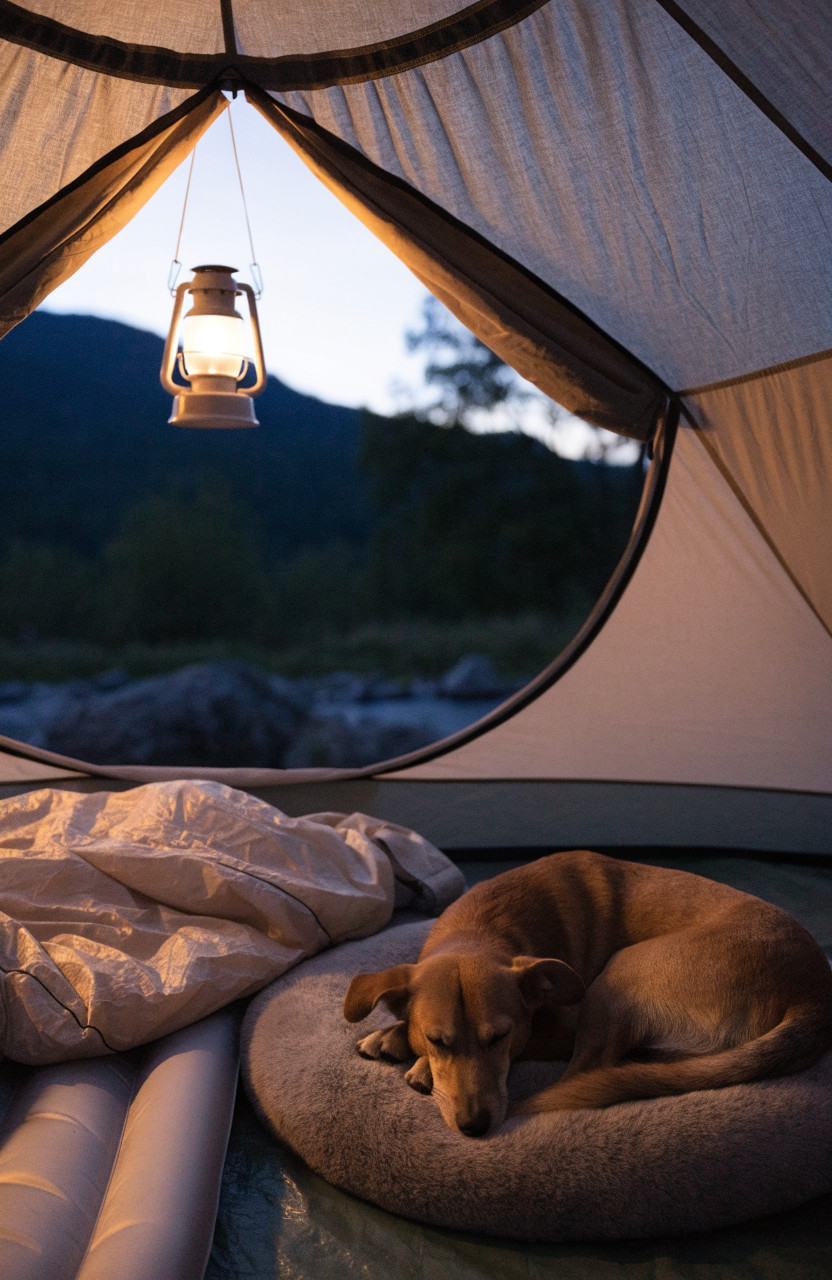
Sleep the dog inside the tent. Tethering a dog outside overnight exposes them to temperature swings, curious wildlife, and other campers’ dogs, and many public campgrounds explicitly require pets inside a tent, vehicle, or kennel at night. A closed car is not a safe alternative in warm weather: interior temperatures rise fast even with windows cracked.
Size the tent for the dog’s sleeping position, not their standing height. A dog that stretches full length needs more floor than the “two-person” label suggests. A common working rule from people who share a tent with a large dog is to treat the dog as an extra person: a three-person tent for two humans and one medium dog, more if the dog sprawls. The door should be easy to open one-handed in the dark.
Inside, give the dog a defined spot on a pad. Ground cold conducts through a tent floor all night; the pad matters more than an extra blanket on top in cool weather. In mild weather a familiar bed is enough. In cold weather add a fleece or a dog sleeping bag, and do not assume a double coat replaces insulation when the dog is still. Condensation wets fur, so crack a vent rather than sealing the tent shut.
Practice the exit before you need it. Zippers, stakes, and guy lines are trip hazards at night. Some people leave the bottom of the door unzipped and the dog on a leash clipped inside so a dog that has to get out does not claw the mesh. That only works if the leash is short enough that the dog cannot reach the fire ring, the neighbors’ food, or the road.
Do not cook in the vestibule or store food, bowls, or scented trash in the tent in bear country. Dog food is food. It goes in the same bear box, canister, or vehicle storage as yours. A bowl left outside overnight is enough to draw animals to the site.
Camp behavior that keeps you from being asked to leave
The written rules are short. The unwritten ones are what neighbors complain about.
Walk the dog away from other sites to toilet. Even if you pick up, a dog urinating on someone’s guy lines or picnic table is the fastest way to start a conflict. Use a trail, a designated pet area, or the edge of the campground loop, not the pad next door.
Pick up solid waste immediately and put it in a trash can or pack it out. On developed sites, bagged waste left “for later” gets opened by ravens and raccoons. In the backcountry, Leave No Trace and Forest Service guidance favor packing waste out. Burial is a fallback, not the default: a hole 6 to 8 inches deep and at least 200 feet from water, trails, and camp, and only where the land manager allows it. Dog waste carries more nutrients and different pathogens than wild scat, and it does not break down cleanly in dry, cold, or high-use soil. Do not bury bags.
Barking during quiet hours is treated as a rule violation, not a personality trait. If your dog alarm-barks at every passing headlamp, the practical options are a site farther from the loop, a white-noise source you have already tested, and a plan to leave if the dog does not settle. Campgrounds can fine you or cancel the stay.
Never leave the dog tied and unattended. A tied dog cannot flee a loose dog, a raccoon, or a person who approaches the site, and many agencies prohibit it. If you cannot take the dog on the hike, that hike is not part of this trip.
Heat, cold, wildlife, and the injuries that show up on day two
Dogs cool mainly by panting. Humidity makes that less effective, so a muggy evening can be harder than a dry afternoon at a similar air temperature. Risk climbs for most dogs once conditions feel hot and there is little shade, and it climbs sooner for flat-faced, thick-coated, dark-coated, senior, and overweight dogs. There is no single safe air temperature. If the dog is panting hard at rest, drooling thick saliva, unsteady, or unwilling to move, stop activity, move to shade, offer small amounts of water, and wet the groin, armpits, neck, and paws with cool water. Collapse, vomiting, very red or bluish gums, or a temperature climbing well above the normal range of about 101 to 102.5°F is an emergency, not a rest break. Do not use ice water.
Paws burn on surfaces that feel merely warm through boots. Press the back of your hand on the ground for about five to seven seconds. If you cannot hold it there, do not walk the dog on it. Asphalt, packed sand, and sunlit rock heat far above air temperature. Shift walks to early morning and evening.
Cold is mostly a ground problem. A dog on a bare tent floor loses heat even if the air inside feels tolerable. Short-coated and small dogs need more cover than a northern breed. Wet fur from rain or a creek crossing removes insulation quickly. Dry the dog before bed.
Wildlife risk runs both ways. A dog that chases a deer, approaches a bison, or investigates a snake is the usual trigger for injury. Leashes reduce that. They do not remove it if the line is long and slack. In bear country, follow the same food storage rules you would without a dog, and do not assume the dog will “alert you in time.” Ticks should be checked for at least once a day, including between toes, in ears, and under the collar. Foxtails and grass awns in the western United States work into ears, noses, and paws and often need a vet. Rinse muddy paws before they come into the tent so you are not treating punctures at midnight.
Know the nearest clinic before you arrive, including after-hours options. Cell service at the site is not the same as cell service on the road out.
A simple order for the first night
- Pitch on level ground clear of the fire ring, the cooking area, and the path other campers use.
- Put the dog’s pad and bed down before you unpack the rest of the car, so the tent already has a job.
- Walk the dog, feed and water them, and give them time to settle before full dark.
- Clip the harness on for the night if the dog might bolt at a noise. Tags stay on.
- Do a last waste walk, then lights out on a schedule close to home.
- If the dog is still pacing after a reasonable settle period, a quiet car with the engine off and windows managed for temperature is a backup only when it is cool enough to be safe. It is not a plan for a hot night.
Frequently asked questions
Can the dog sleep outside the tent if the weather is mild? On most public campgrounds, no. Night rules usually require the dog inside a tent, vehicle, or kennel, and an unattended tie-out is both a safety problem and often a violation. Mild air temperature does not remove wildlife or other-dog risk.
How much bigger should the tent be? Large enough for the dog to lie in their normal sleep position without pinning anyone against the wall. Count a sprawling medium or large dog as an extra sleeper when you read capacity labels, and prioritize floor area over peak height.
Is dispersed camping easier with a dog than a campground? It is often more permissive on trails and quieter at night, and it is also farther from help, with more wildlife and no trash cans. Pack out waste, keep the dog leashed or under direct control, and do not treat the lack of neighbors as permission to let the dog roam.
What if the dog will not stop barking? Check for a real trigger first: another dog, a raccoon, a full bladder, heat. If it is alarm barking and it continues into quiet hours, move farther from other sites if you can, or leave. A barking dog is one of the few problems campgrounds will end your stay over.
Do I need a separate dog tent? Only if the dog already sleeps well in one and you want a shaded daytime rest spot you can watch. A dog tent is not an unsupervised kennel, and it does not solve heat. For the night, the shared tent with a pad is the more reliable setup.