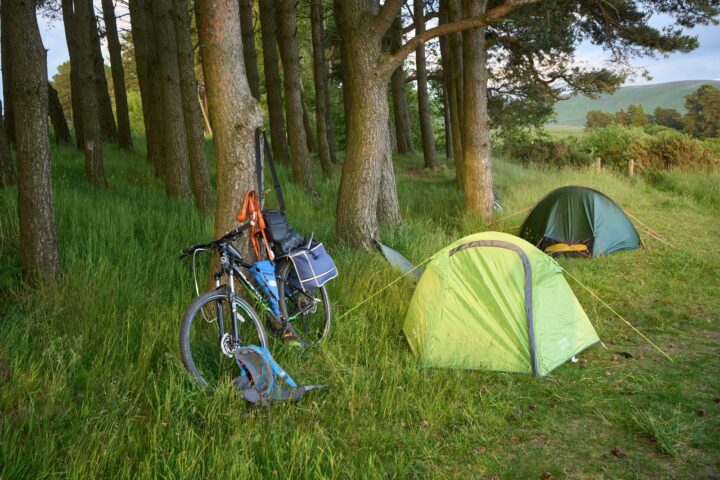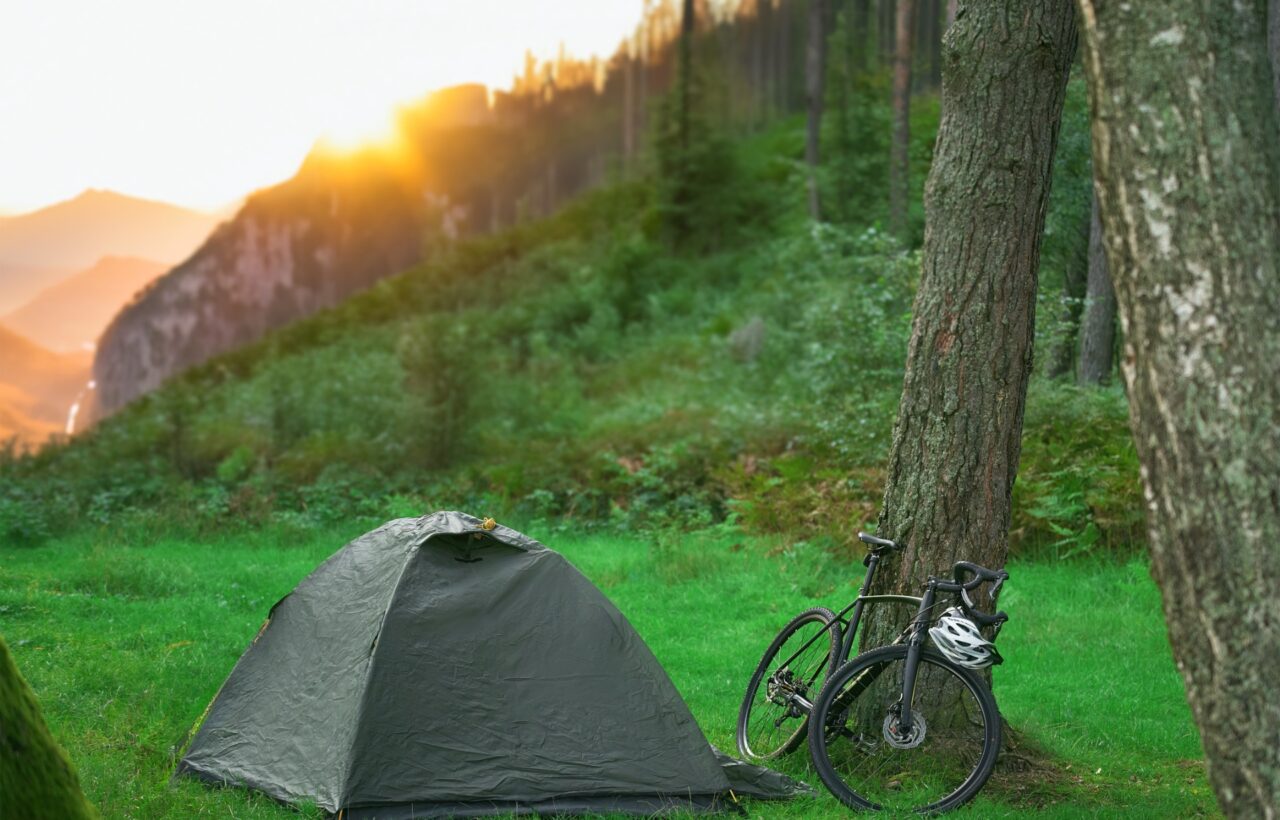
Bike tent camping is overnight travel by bicycle with a tent as the shelter. The tent that works is almost always a backpacking tent, sometimes sold in a shorter-pole “bikepack” version so the packed bundle fits a handlebar roll, frame bag, or pannier. What decides whether the night goes well is not the label on the stuff sack. It is packed length, whether the tent can stand on hard ground, and whether you still have a dry place for shoes, a helmet, and a wet jacket after the fly goes on.
A car-camping dome will ride, but it will also dictate the route. Extra kilos show up on every climb, and a long pole bundle that will not fit a bag ends up strapped somewhere it can swing into a knee or a front wheel.
What the bike changes about camping
Two styles of bike travel use tents, and they do not punish bulk the same way.
Cycle touring usually means racks and panniers. A rear pannier can swallow a conventional backpacking tent, poles included, if the folded pole length is shorter than the bag’s depth. Riders on this setup can trade a little weight for a roomier floor and a fly that shrugs off a wet week.
Bikepacking usually means soft bags on the bars, frame, fork, and saddle, with no rack. Volume is tight, and the awkward piece is the pole bundle. A tent that packs to a short cylinder is easier to live with than a lighter tent whose poles are 50 cm long and will not go anywhere.
A typical lightweight tent is five pieces: inner body, rainfly, poles, stakes, and an optional footprint. On a bike those pieces do not have to stay in one sack. Fabric can go in a seat pack, poles along a frame bag or under the top tube, stakes in a jersey pocket. Splitting the load is often more useful than buying a tent marketed only to cyclists.
A bike-specific tent is a packing choice, not a different shelter
Most tents used for bike camping are backpacking tents. A bikepacking model is usually the same design with shorter pole sections and a stuff sack meant to strap to bars.
Big Agnes, for example, uses a 12-inch Shortstik pole set on bikepacking versions of tents such as the Copper Spur. On the Copper Spur HV UL2, that change shortens the packed length by about 15 cm, or 6 inches, compared with the standard backpacking pole set. Other brands, including MSR, use a similar idea: pole segments around 12 to 14 inches so the bundle fits a handlebar harness or a small bag.
That difference matters if you are on drop bars with a harness and no rack. It matters less if you have panniers deep enough for standard poles, or if you are willing to carry poles outside a bag, lashed to a rack or fork cage. Paying a premium only for shorter poles is reasonable when the rest of the bike has no place for a long bundle. It is a poor trade if a solid three-season backpacking tent already fits.
Weight ranges used by people who ride with tents are a guide, not a rule. A workable bike tent often lands between about 1 kg and 2 kg. Ultralight single-wall and bivy-style shelters can sit near half a kilogram, at the cost of space, storm performance, or both. Heavier touring tents are fine when the bike, not your shoulders, carries them, as long as the packed shape still fits.
How to choose one
Match the tent to the trip, not to a best-of list.
| Decision | Favor this | Accept the tradeoff |
|---|---|---|
| Rackless bike, drop bars | Poles that fold under about 14 inches, or a design you can split | A little more money, or a less “complete” single sack |
| Panniers and a rack | Any solid backpacking tent that fits the bag | Slightly more weight for more floor space |
| Campgrounds, towns, hard pads | Freestanding or semi-freestanding | A bit more weight than a tarp tent |
| Remote dirt, soft ground, fair weather | Staked single-wall or tarp for lower weight | Slower pitch, needs stakes and guylines |
| Two riders | One shared tent, components split | Less privacy, one failure point |
| Wet, windy, bug-heavy routes | Double-wall, full fly, real vestibule | More bulk than a bivy |
Packed length before trail weight
On a bike, a tent that will not fit is heavier in practice than a tent that is 200 g more but disappears into a bag. Check the folded pole length on the spec sheet, then measure the bag you will actually use. Handlebar rolls hate anything much over about 40–45 cm unless the bars are wide and the harness holds the load off the cables.
If the poles are the problem and the fabric is not, carry them separately. A pole sleeve lashed under the top tube or along a fork leg solves tents that would otherwise be “too long for bikepacking.”
Freestanding when the ground will not take a stake
A freestanding tent holds its floor corners with the pole structure, so the inner can stand without stakes. A semi-freestanding design, often a single Y-shaped pole, still needs the head-end corners staked to take shape. A non-freestanding tent is a sail until every stake or guyline is set.
Bike travel hits hard surfaces more often than a hiking trip does: campground gravel pads, picnic shelters, concrete at a trailhead, a porch when a storm arrives early. Stakes fail there. Freestanding and semi-freestanding tents still need staking in wind, but they give you a shelter when the only flat spot will not hold a peg. On a long tour through towns and varied ground, that flexibility is worth more than the last few hundred grams.
Vestibule space is bike storage
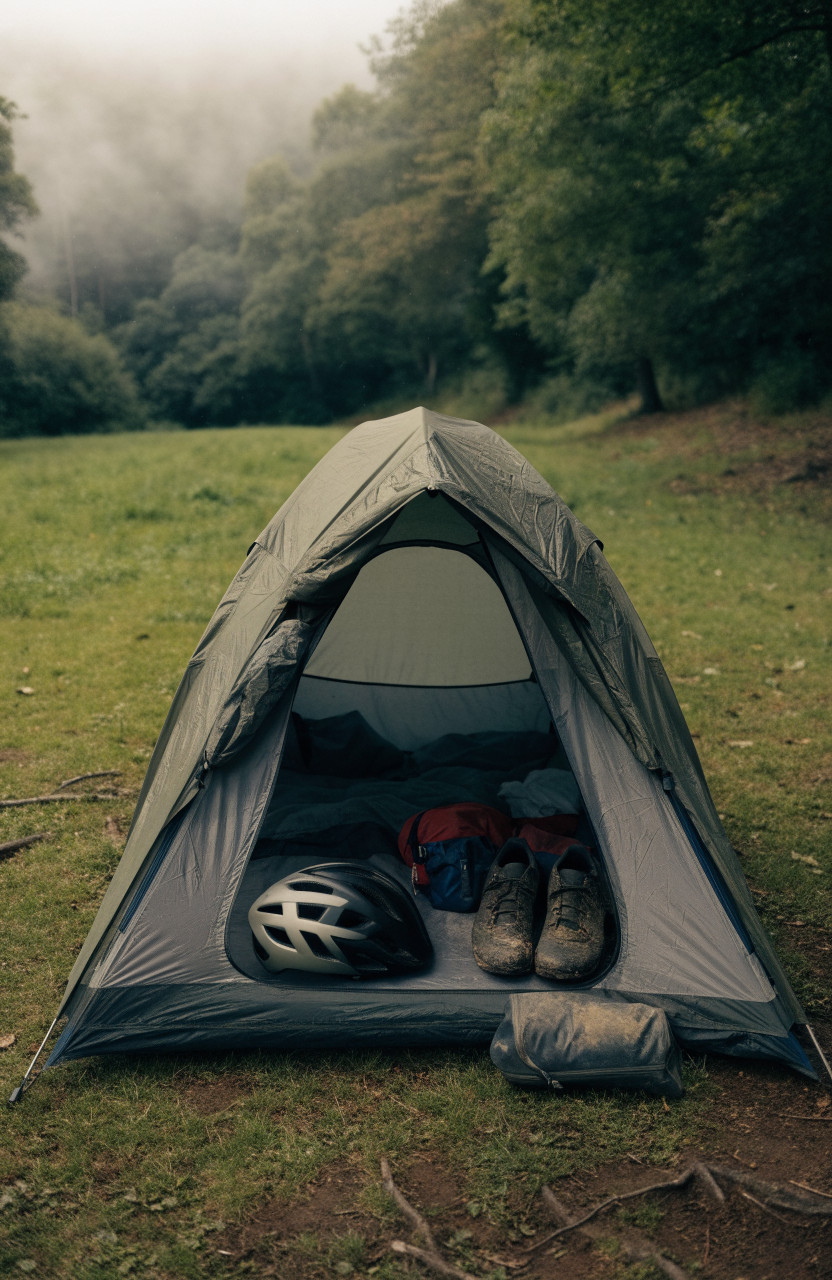
Shoes, a helmet, panniers, and a wet jacket do not belong on the sleeping pad, and they should not sit in the rain. A vestibule large enough for footwear and a small dry bag is the feature riders miss once and then shop for. Two doors help when two people are sharing, so neither has to climb over the other after a night ride to the toilet block.
Inner pockets and fly loops for a helmet are convenient. They are not a reason to reject an otherwise better tent.
Season rating is a weather promise, not a calendar
A three-season tent is the default for bike camping: mesh for bugs and airflow, a fly for rain, enough structure for ordinary wind. Four-season tents add weight and block ventilation for conditions most bike trips never see. A two-season or summer tent is fine for settled, dry weather and a poor choice if the route can turn wet overnight.
Floor waterproofing is only as good as the ground under it. A thin backpacking floor punctures on sharp gravel. A footprint, or a piece of polycro cut to the tent’s outline and stopped short of the edges so rain does not run under the floor, is cheap insurance. Do not let the footprint stick out past the fly, or it becomes a funnel.
One person, two people, or a shared tent
Solo riders usually do better in a one-person tent. A two-person tent used by one rider is luxurious and also a large wet surface to pack each morning. Two riders should share one tent and split the pieces: one carries poles and stakes, the other carries body and fly. That is one of the largest weight savings available, and it leaves both bikes more balanced than two complete shelters.
Manufacturer “person” ratings assume narrow pads and no gear inside. If you sleep on a wide pad or keep bags in the tent, size up, or accept that the vestibule is the gear closet.
Where the tent goes on the bike
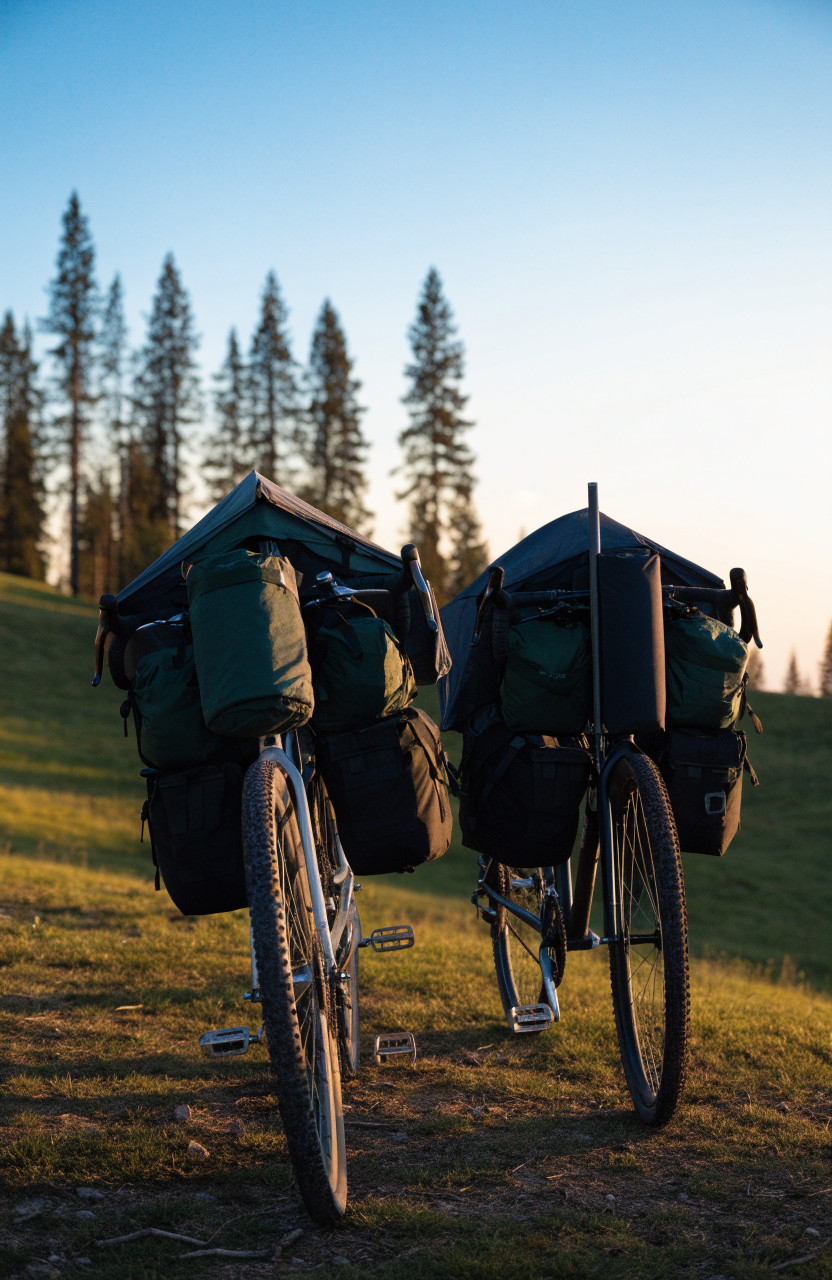
The stable places, in rough order:
- Inside a pannier or rack trunk, if the pole length allows.
- In a handlebar harness, as a firm cylinder that clears the front tire and does not press on brake hoses. Wide flat bars forgive this more than narrow drop bars.
- Split: fabric in the seat pack, poles in or alongside the frame bag, stakes somewhere small.
- Strapped to a fork cage or rack deck, only if the load cannot swing into the wheel.
A bare pair of straps around the bars works for a short overnight. It also lets the bundle sag onto cables and shift when you stand to climb. A harness or a roll bag with its own straps is more predictable once the trip is longer than a weekend.
Pack the tent so tomorrow’s wet fly does not soak the sleeping bag. A separate dry bag for the fly, or the fly on the outside of the bundle, keeps a damp shelter from contaminating dry kit. Stuffing silnylon is normal and avoids hard crease lines. Dyneema composite fabric is the exception: fold and roll it, do not cram it.
Before the first ride, load the bike and push it through a slow turn and a bump. If the bars feel heavy or the front wheel wanders, the tent is too high or too far forward. Move mass lower and closer to the steering axis.
Avoid packing the tent at the top of a tall handlebar stack, where the extra height makes the bike wander. Check pole length against the planned load before the trip, too, rather than discovering the problem with the bike already packed in the driveway.
Pitching when you are already tired
Stop with daylight left. Bike camping fails more often from a late arrival than from the wrong tent. A flat, slightly raised patch that drains, clear of dead branches, is worth an earlier halt.
Clear twigs and stones, lay the footprint if you use one, stake the corners that need tension, then raise the poles. Color-coded pole ends on many modern tents exist so this can happen in the dark with a headlamp. Practice the pitch once at home so the first real night is not the instruction sheet.
Point the low end of a tunnel, or the door you will not use, into the expected wind. Leave guylines attached in the stuff sack so you are not hunting for them in rain. In calm weather a freestanding tent can wait for stakes. In wind, stake it before you walk away to filter water.
An empty-looking road is no proof that wild camping is legal. Rules differ by country, state, and landowner, so campgrounds, permitted sites, and ask-first stops are the reliable default until the local rule is clear.
Rain, condensation, and a wet morning
Double-wall tents manage condensation better because the inner and fly are separate and air can move between them. Single-wall tents save weight and still wet the inside of the fabric on a cold, still night. Vent openings matter more than the waterproof rating printed on the hangtag. Close them only when rain is driving in.
Do not pack a soaking tent into a closed bag and leave it for the afternoon if you can avoid it. Shake it, wipe the worst of the water, and strap it where air can reach it. At the next stop, pitch the fly alone for a few minutes if the route allows. A tent stored damp for days grows mildew. A tent that is damp for one riding day and dried that evening usually does not.
Cook outside the tent. Stoves in vestibules are a common way to melt a fly or fill a small space with fumes. The vestibule is for boots and a pot that has already been brought off the flame, not for the flame.
The bike at night
The tent does not secure the bike. In a campground, lock the bike to a fixed object if one exists, or lock the wheels to the frame so it cannot be ridden off. In remote country, theft risk is lower and weather is the larger problem: a bike left in the open collects dew, and a leather saddle or an untaped bar tape suffers for it.
Riders sometimes run a guyline through the frame so movement wakes them, or roll the bike partly under a large vestibule. Both are alarms and weather covers, not locks. In a town or a busy trailhead, a lock is the relevant tool. Taking a wheel inside the tent makes the bike harder to ride away. It does not make it hard to carry.
When a tent is the wrong shelter
A tent is the versatile choice: bugs, privacy, weather, a place to change, and a shared floor for two people. It is the wrong tool when the trip is a fast overnight in settled weather and every gram on the bars is a problem. A tarp and bivy, or a hooped bivy, can cut shelter weight sharply if you already know how to site a tarp and you are not camping among mosquitoes or in a busy campground.
Hammocks need trees at the right spacing and a bug net in season. They are a poor default for high, open, or desert routes. Shelters that use the bike as a pole exist. They save a pole set and tie you to the bike for the night, which is awkward if you want the bike locked elsewhere or if the bike is muddy.
If you will own one shelter for mixed trips, including travel where you cannot predict the ground or the insects, make it a tent.
Frequently asked questions
Can I use a normal hiking tent? Yes. If the poles fit your bags, or you can carry them separately, a backpacking tent is what most people bike-camp with. The bike-specific version is worth it when shorter poles solve a packing problem you actually have.
How heavy is too heavy? On a rack with panniers, a 2–2.5 kg tent is reasonable if you want the space. On a rackless bike, staying under about 1.5 kg for a solo shelter keeps the bars usable. The number that matters is the weight you will still carry after the third climb, not the minimum published trail weight with stakes removed.
Do I need a footprint? On abrasive ground, yes, unless the tent has a tougher floor than typical ultralight nylon. Cut it smaller than the tent floor so water does not collect on it and run inside.
What if it is already raining when I stop? Pitch the fly first if the tent allows a fly-only or fast-fly setup, get the inner out of the rain, then finish staking. If it does not, a large waterproof bag over the packed tent while you clear the site buys a minute. This is another reason to have pitched the tent once when it was not raining.
Is a two-person tent better for one rider? Only if you want sitting space in bad weather and can spare the bulk. For most solo bike trips, a one-person tent with a usable vestibule is the cleaner choice.