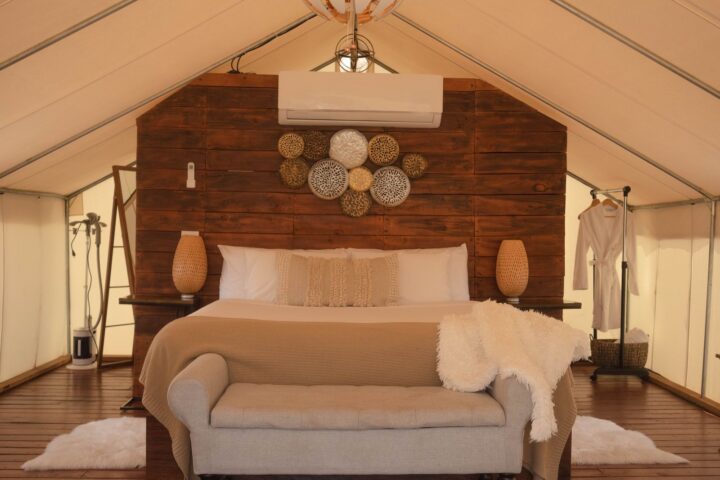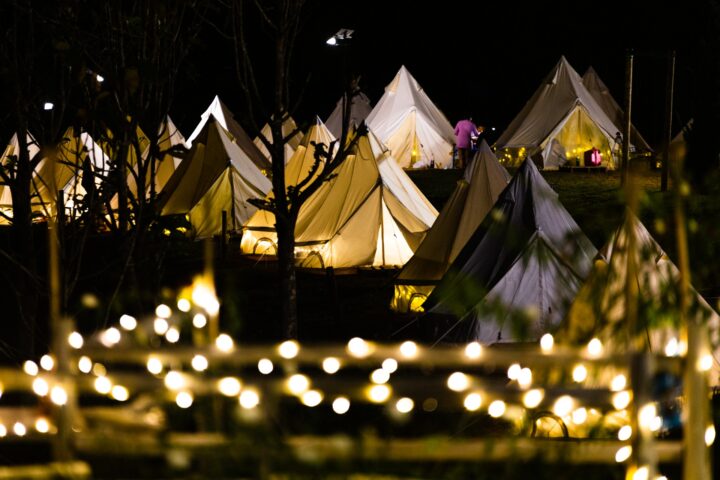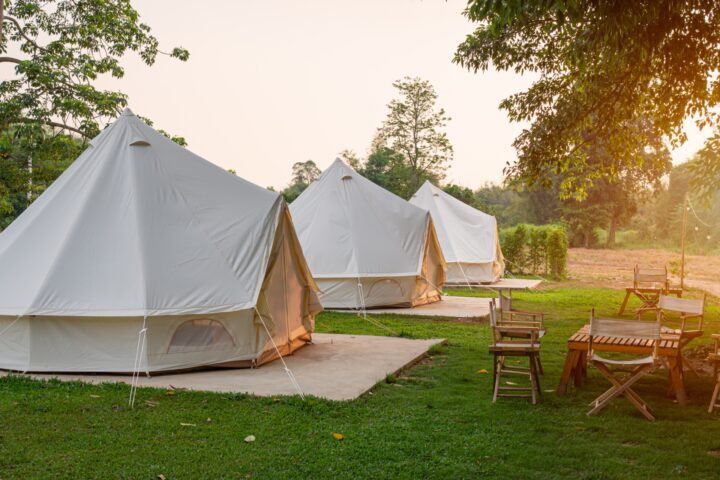

Site choice comes first in a glamping tent setup, and the pitch comes second. The floor has to sit on ground that will not puddle, the canvas has to be staked before it is raised, and the guy lines have to hold the shape that sheds rain. Bell tents are usually standing in well under an hour once you know the sequence. Safari and wall tents take longer because the frame has to be square before the canvas goes on. The manufacturer’s order still wins over any general method.
Pick the ground before you unpack the canvas
A flat patch that drains is worth more than a view. Water runs to the lowest point, so a slight bowl in the grass becomes a pond under the groundsheet after one storm. Look for level or gently sloping ground, firm enough to hold a stake, and clear of roots and sharp rock. Avoid marsh edges, dry creek beds, and the bottom of a slope where runoff collects.
Check overhead before you commit. Dead limbs and lone tall trees are a real hazard in wind. Door direction matters too: face the entrance toward the view and away from the prevailing wind, and leave a clear arc outside the walls for guy lines. Most bell and safari pitches need stakes roughly 1–2 meters (about 4–6 feet) out from the wall, in line with the roof seams. If that ring is blocked by a path, a fire pit, or another tent, the pitch will never tension correctly.
Clear sticks and stones from the footprint. Canvas and sewn-in groundsheets puncture more easily than backpacking tents, and a lump under a bed is miserable for the whole stay. If you are laying out more than one tent, space the edges so doors do not face each other and guy lines do not cross walkways. Hosts planning a small site often aim for at least 30–40 feet between tent edges so the pitch still feels private.
Match the sequence to the tent type
Glamping tents are not one product. The order of work changes with the structure.
| Tent type | What holds it up | Typical first pitch | What fails if you rush |
|---|---|---|---|
| Bell / Sibley | Center pole, door A-frame, sewn-in floor | Often 30–40 minutes the first time; about 15 minutes with two people after that | Floor not a true circle; guy lines off the seams |
| Safari or wall tent | Ridge and leg frame, or internal poles | Several hours the first time for a full canvas wall tent | Frame not square; canvas dragged across gravel |
| Rigid-frame lodge | Steel or timber skeleton, then canvas skin | A work session, not a casual pitch | Bolts left loose; cover tensioned before the frame is true |
Follow the bag’s own diagram for pole pockets, color codes, and which stakes are for the floor versus the guys. The steps below are the shared logic across brand guides, not a substitute for that sheet.
How to set up a bell tent
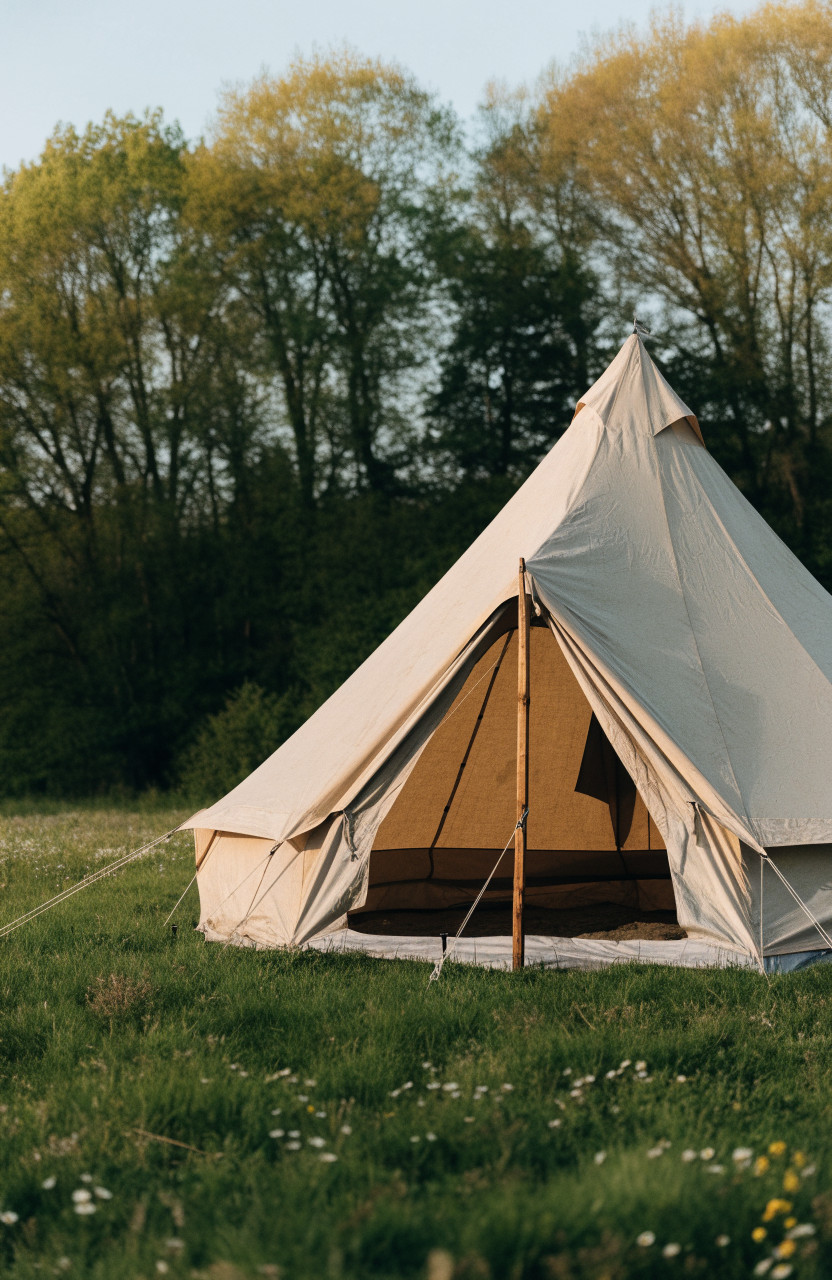
A bell tent is the usual weekend glamping tent: one center pole, an A-frame at the door, and a circular floor.
- Lay the tent with the groundsheet down. Find the door and rotate the whole bundle until the entrance faces the direction you want. Do this before any stake goes in.
- Stake the floor first, lightly. Start at the door and opposite points, then work around in pairs so the floor pulls into a circle rather than an oval. Drive the smaller pegs through the groundsheet eyelets at about 45 degrees, leaning away from the tent. Leave a little adjustment. Pull the floor snug, not drum-tight. Wrinkles in the floor become ridges under a mattress.
- Attach the guy lines to the loops at the seam ends if they are not already tied. Do not tension them yet.
- Take the center pole inside, shoes off, and raise it into the cone at the roof. The base should sit at the marked center of the floor. A second person outside, holding a wall, makes this much easier.
- Fit the door A-frame. It is usually easier to finish assembling it inside. The spike goes through the hole above the door; the feet sit in the pockets. Fit any external rain cap the design uses.
- Stake the guy lines along the roof seams, again at about 45 degrees, roughly 1–2 meters out. Start above the door, then opposite pairs. Leave the sliders with room to move both ways — about half a meter of adjustable loop is a common target — so you can ease off after rain as well as tighten.
- Walk the circle and even the tension. The tent should be symmetrical, walls free of a deep sag, and no single rope bar-tight. Horizontal sag usually means the nearest guy is loose. A vertical wrinkle often means the floor peg on that side is too tight.
Open the roof vents once the shape is right. Condensation is warm breath hitting cold canvas; vents at the peak are how that moisture leaves.
How to set up a safari or wall tent
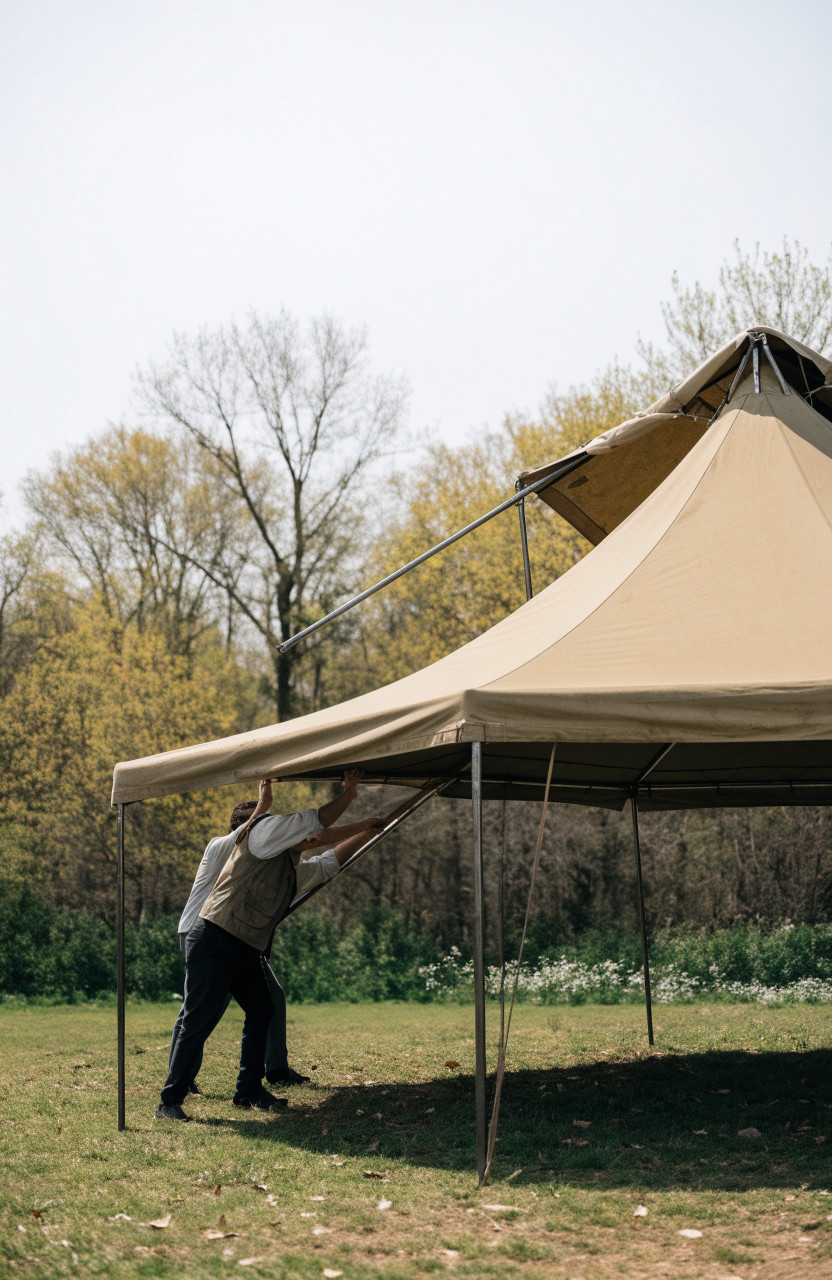
Safari and wall tents trade the single pole for a frame. The canvas is a skin, not the structure.
Inventory every pole, angle joint, and stake before you start. A missing ridge connector found halfway through is how a four-hour pitch becomes an all-day one. On grass, peg the four corners (and any rear assembly the model uses) so the footprint cannot creep while you raise the roof. On a framed lodge, build the skeleton to the drawing first, tighten bolts only after the bases are square, then drape the cover. Do not drag the canvas across gravel or asphalt while you find the door; grit ground into the fabric is difficult to get out and wears the coating.
Raise the roof on the reinforced panels, not on a random point of canvas. Adjust leg height until the walls are taut and the ridge is level. Stake the mud flap or sod cloth, then the guy lines, at least about five feet out on a wall tent and along the roof slope so wind load goes into the ground rather than into the seams. Peg ventilation gussets and awnings last. If an awning can hold water, set one support slightly lower than the other so rain runs off instead of pooling.
A first canvas wall-tent pitch is commonly a half-day job, including sorting parts. Later pitches are much faster once the joints are familiar.
Peg the floor down before the pole goes up, even when the weather looks calm. A gust during that gap can flip a bell tent that is not yet tied down.
Anchoring that actually holds
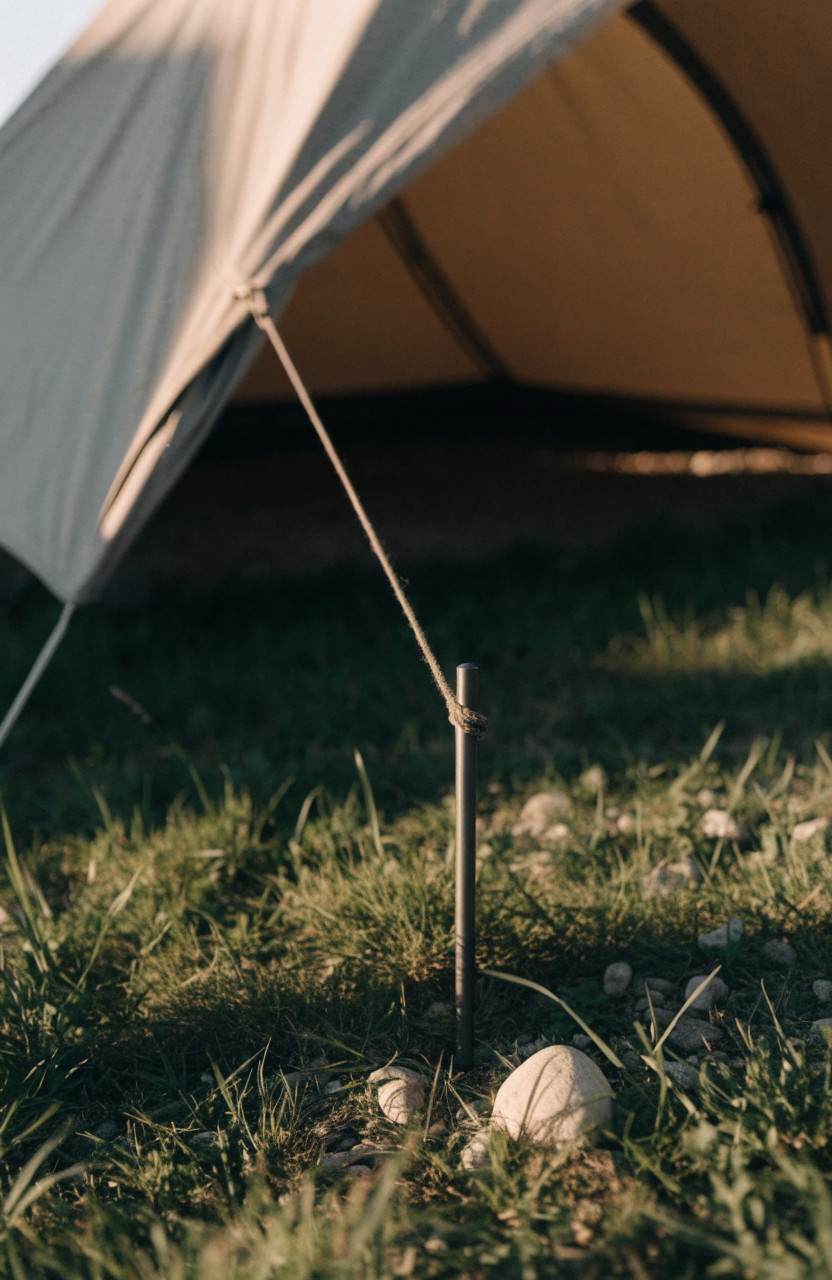
Calm weather at setup is not a reason to skip lines. Canvas has a lot of surface area, and a gust treats it like a sail.
Stake angle matters more than how hard you swing the mallet. A peg driven straight down pulls out under guy-line load. A peg at about 45 degrees, top leaning away from the tent, bites the soil. Use every floor peg and every guy the tent shipped with. In soft ground, longer or auger-style stakes hold better than short pins. In very hard ground, longer steel spikes are the usual upgrade; rocks alone are a poor substitute unless the design is specifically ballasted.
On a wooden platform you cannot peg through the deck and expect the same geometry. Screw the groundsheet down through the metal grommets, with a washer so the screw head cannot pull through — not through the elastic loops, which are not meant to be tensioned and will fail. Guy lines still need to leave the tent along the seams at roughly the same angle as a ground pitch, about 1–2 meters out, tied to eye bolts or posts. A line tied straight down the platform edge changes the load on the canvas. The platform itself has to be anchored, or a strong wind can lift deck and tent together.
Canvas moves after weather. It slackens when wet and tightens as it dries, so tension set on a dry afternoon will be wrong after the first rain. Recheck guys in the morning and again if the forecast turns. A line should have a little give when you press it. Zero flex stresses seams and pole tips; a sagging line lets the wall flap and wears the attachment point.
Resist pulling every rope as tight as it will go. Over-tension distorts the cone, stresses seams, and leaves no room for canvas to shrink as it dries. Recheck tension in the morning, since a pitch that looked right at dusk often sags overnight.
Finish the inside without trapping moisture
Bring furniture in only after the shell is tensioned. A bed or stove moved around inside a half-pegged tent drags the floor off its circle.
A separate ground tarp under the tent, cut so it does not stick out past the walls, adds a barrier against ground damp. If it extends beyond the canvas, it becomes a funnel for rain. Inside, a rug over the groundsheet is for comfort, not waterproofing. Keep a clear path to the door and do not block the low vents.
Ventilation is part of setup, not an afterthought. Open opposing roof vents at pitch so moist air can leave. Cooking inside, drying wet clothes on the center pole, and running a heater with every vent shut are the usual reasons a “waterproof” tent drips on the bedding. If the tent is rated for a wood stove, use only the flashing and pipe layout the maker specifies, and keep clearances. A stove jack is not a license to improvise a flue.
For a short stay, a raised bed or a thick mattress on a cot beats a mattress straight on the floor: the air gap stays warmer and the groundsheet is easier to dry. For a semi-permanent pitch, a deck sized a little larger than the tent gives you a dry step-out, but only if the guy-line geometry above is preserved.
Weekend pitch or a tent that stays up
A weekend setup should come down dry, fold along the original creases, and store loose rather than compressed while any damp remains. A seasonal pitch needs a different standard: stronger anchors, a platform or well-drained pad, and a habit of walking the guys after wind and rain. Spacing, privacy, and a dry path to the tent matter as much as the canvas once people are paying to sleep there. Neither version is finished when the center pole is up. It is finished when the floor is round, the lines share the load, and the vents can actually move air.
Frequently asked questions
Can one person set up a glamping tent? A bell tent can be pitched alone once you know it, but the center-pole raise is awkward without a second pair of hands. Safari and wall tents are a two-person job in practice because the frame and canvas are heavy and need to stay square while they go up.
How long does glamping tent set up take? A familiar bell tent is often about 15 minutes with two people. A first attempt is commonly half an hour to 40 minutes. A canvas wall tent is often several hours the first time and faster after the frame joints are known.
Do guy lines matter if the forecast is calm? Yes. They hold the roof shape that sheds water, and weather changes after you finish. Stake them on every pitch.
Can you set one up on a deck? Yes, if the deck is strong enough for the tent plus people and furniture, and if guy lines still run out along the seams to eye bolts or ground anchors. Do not rely on elastic loops as the structural fixing.
Why is the inside wet when the canvas did not leak? That is usually condensation. Warm, moist air from breathing, wet clothes, or cooking hits cold canvas and drips. Open peak vents at setup, keep wet gear out of the sleeping area, and do not let an inner layer sit against the outer canvas.