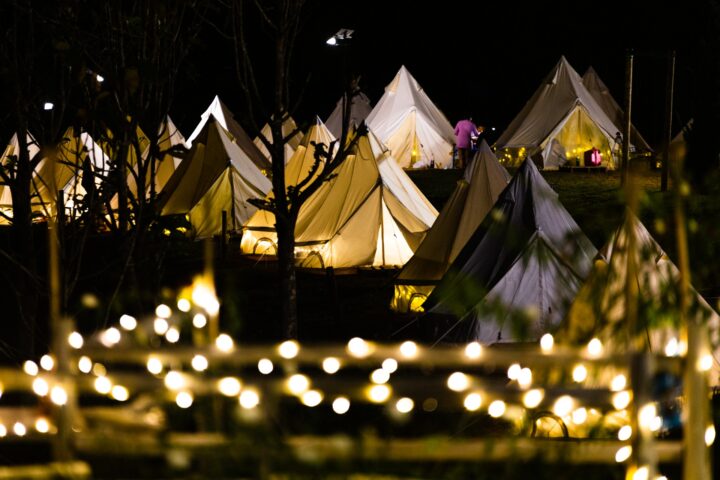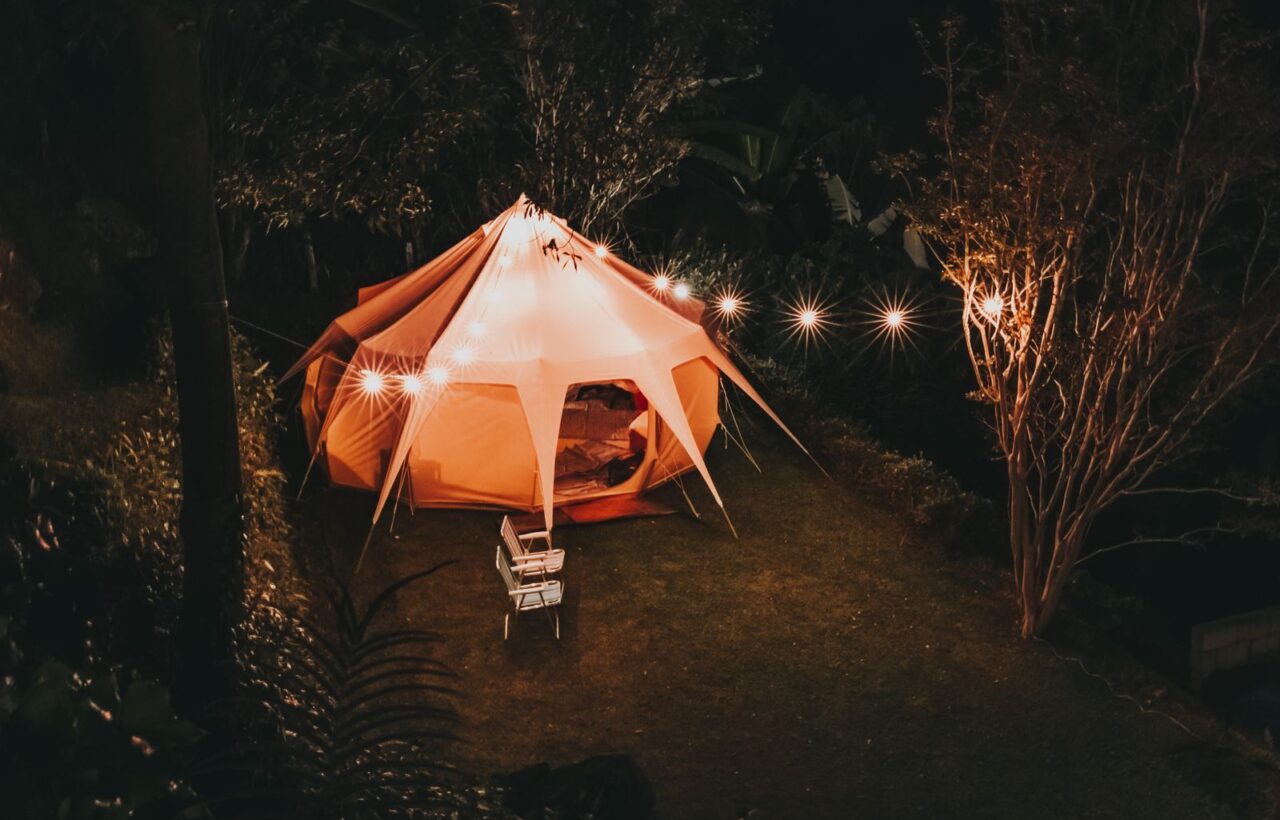

A glamping tent is a shelter with standing room, a real bed, and enough weather protection that the night does not become a gear problem. The useful choice is the shape that fits the season, the group, and how long the tent has to stay up, not the one that looks best in a resort photo.
These 15 glamping tent ideas cover the structures people actually book, buy, or pitch: bell tents, safari lodges, yurts, domes, bubbles, tipis, and stove-ready canvas. Each one works in a narrow set of conditions. A clear bubble that suits a dry anniversary weekend can overheat by noon and lose privacy after dark. A heavy wall tent that sleeps a family for a week is a poor festival carry.
Match the tent to the stay before you pick a style
Three constraints decide more than décor.
How long it stays up. A weekend bell tent can come down on Sunday. A safari lodge or yurt with a deck, bathroom, and power is a semi-permanent build, often needing a platform, permits, and a plan for drainage.
What the weather actually does. Canvas breathes, which cuts condensation compared with sealed plastic, but it still needs vents. Clear panels and bubble shells gain heat fast and lose it fast. Cold sites need a factory stove jack or another safe heat source, insulation, and a floor that is not sitting on bare ground. Hot sites need shade, roof vents, and mesh you can open without letting insects in.
Who has to use it. Couples can live with sloping bell-tent walls. Families need vertical walls or a larger diameter so beds, bags, and a table all fit without crawling. Guests who will not walk to a shared bathroom need an ensuite or a site that already has one close by.
15 glamping tent ideas
1. Classic canvas bell tent for a short couples stay
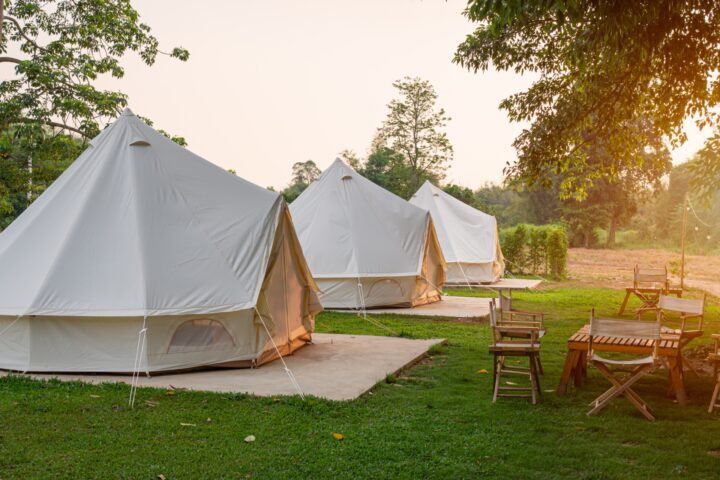
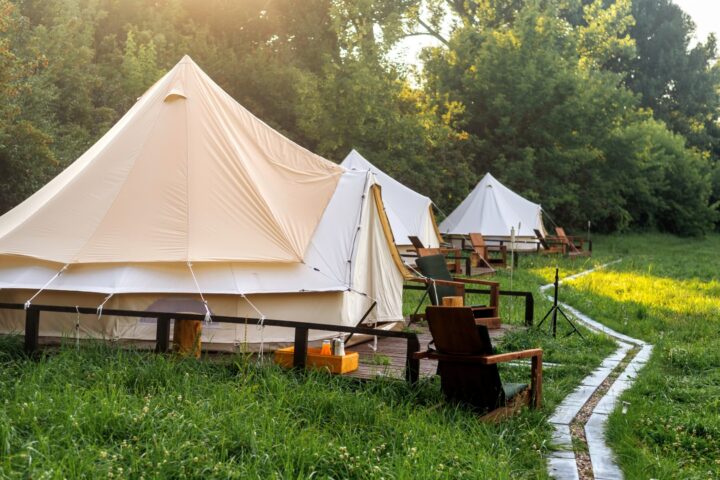
A bell tent is a circular canvas shelter held by one center pole, with walls that slope to the ground and a ring of guy lines. A 4 meter (about 13 foot) model is the usual couple size: enough for a bed, two chairs, and bags, with standing height only near the pole.
It works for warm-weekends, farm stays, and backyard trials because two people can pitch it, and cotton or polycotton canvas handles light rain better than a thin festival dome once it is properly tensioned. The limit is the slope. Floor area on the spec sheet is not usable floor area. Keep the bed off the low walls, and do not plan a wardrobe along the edge.
2. Stargazer bell tent with a clear roof panel
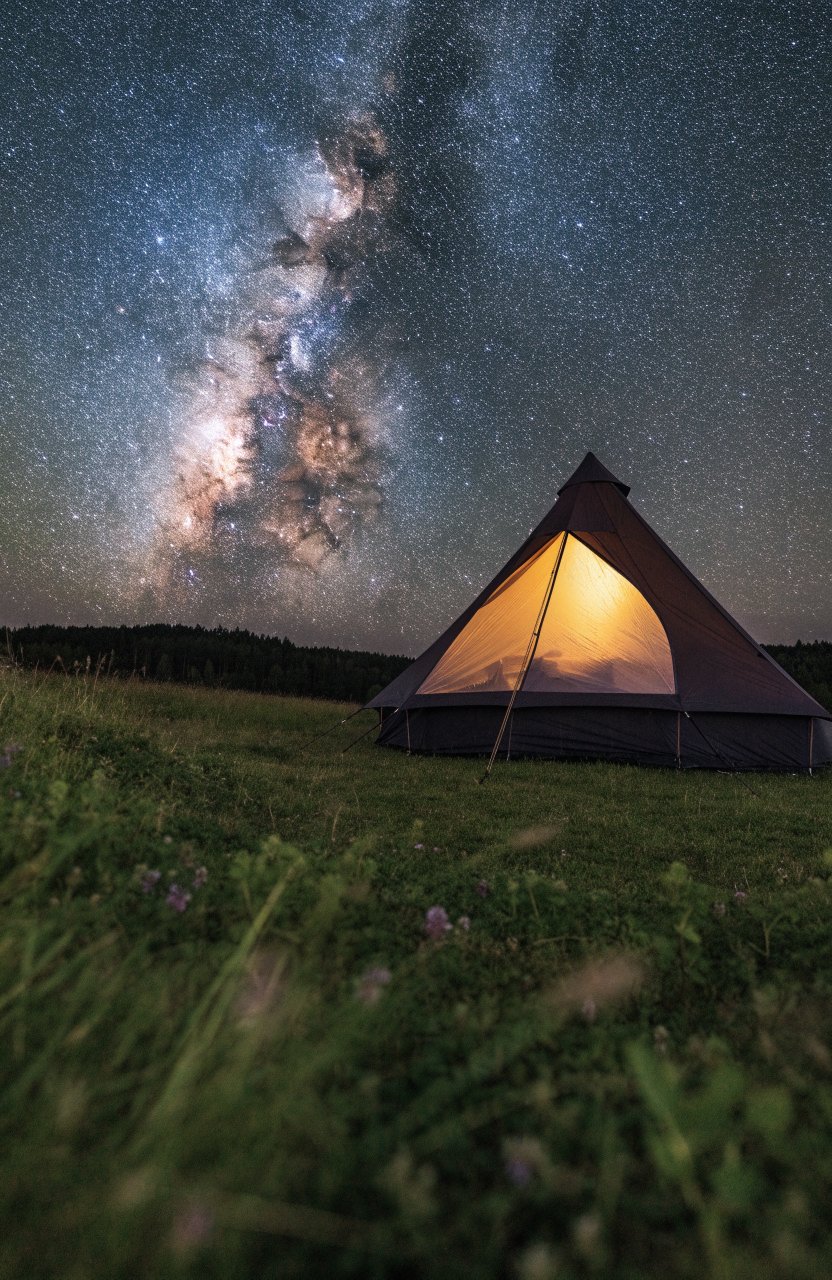
The same bell shape, with vinyl or polycarbonate panels in the roof so you can lie in bed and see the sky. It is the simplest “special occasion” upgrade that still packs down.
Clear panels are a heat and condensation trade. In full sun they turn the peak into a skylight greenhouse, so site the tent under partial shade or use a cover in the afternoon. At night the panels cool faster than canvas, which means moisture from breath will bead there first. A small roof vent left cracked does more for comfort than sealing every zipper.
3. Family bell tent in the 5 to 6 meter range
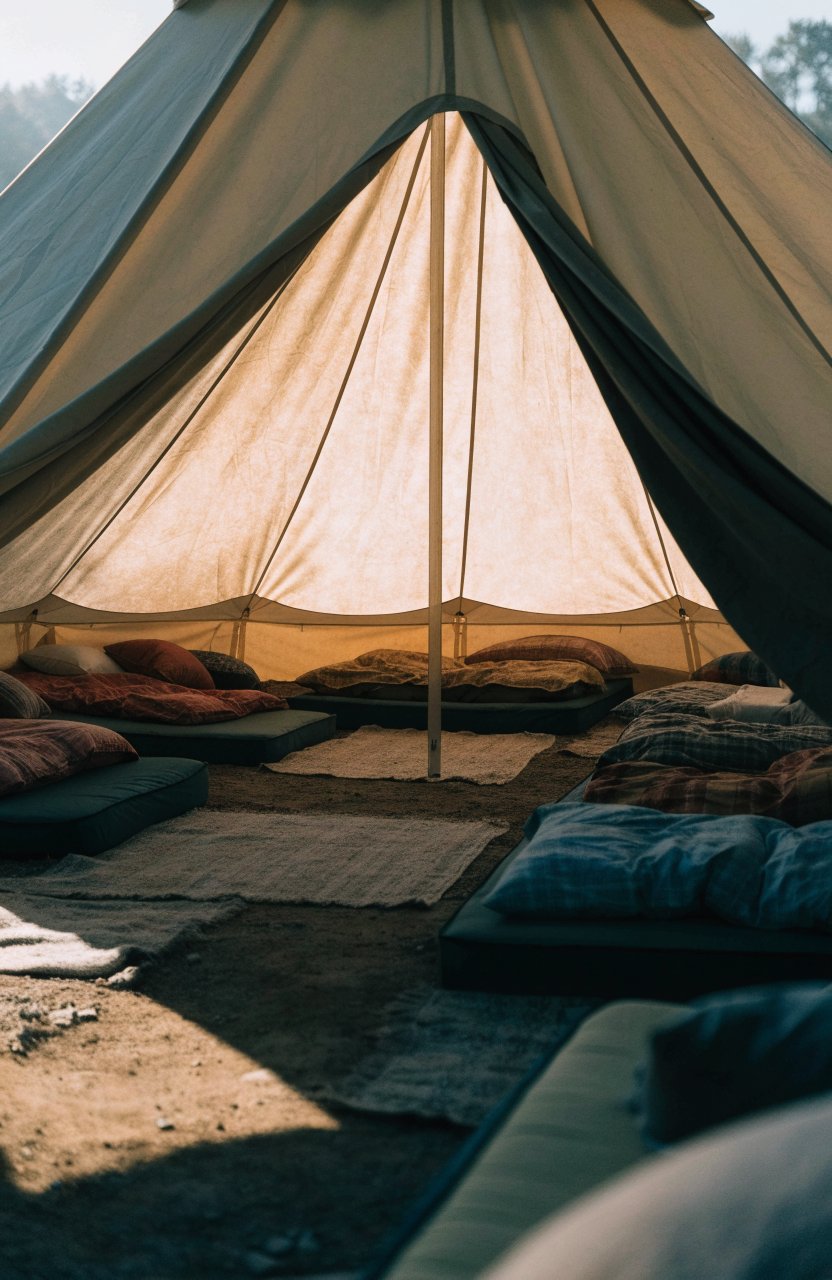
A 5 meter bell tent has roughly 20 square meters of floor; a 6 meter model is closer to 28. That is the point where a family can sleep four to six people without stacking gear on the beds, provided the center pole stays clear of the sleeping layout.
These are still portable, but weight jumps quickly. Commercial canvas bell tents in this class are often 35 to 50 kilograms or more, so they suit a car, not a walk-in site. Guy lines need a wide, peg-friendly circle. Rocky ground or a packed festival pitch is where these fail, not the fabric.
4. Canvas wall tent for a week-long base
Wall tents, often sold as safari tents, drop the slope. Four straight sides and a framed or pole-supported roof give you headroom at the edges, so a bed, table, and storage can sit like they would in a room.
That geometry is why they suit longer stays and hunting or family basecamps. They are heavier and slower to pitch than a bell tent, and many are meant to stay up for a season rather than move every morning. A sewn-in groundsheet blocks ground moisture; a raised wooden platform does it better if the tent will not move.
5. Safari lodge tent with a deck and ensuite
This is the resort version of the wall tent: canvas on a frame, usually on a platform, with a bedroom, sitting area, and a bathroom pod or attached washroom. Doors open onto a deck for cooking and sitting outside the sleeping space.
It feels like a cabin because the floor is solid and the furniture does not have to dodge a center pole. It is a build, not a camping kit. Drainage under the platform, a safe electrical run, wastewater, and local rules on temporary structures matter more than the throw pillows. Canvas still needs airflow, or the bathroom will drive mildew.
6. Two-story or loft safari tent
A framed safari tent with a mezzanine or second sleeping level. Resorts use them for families who want parents and children separated without booking two structures.
The loft only works with a proper stair or ladder, a guard, and a frame rated for the load. It is a poor DIY copy of a resort photo. If you are booking one, ask what the upper level is rated for and whether it has its own vent. Heat pools upstairs.
7. Glass-wall safari tent
A safari frame with a full glass or polycarbonate end wall facing the view. You keep canvas privacy on the other sides and a wide outlook from the bed or sofa.
Glass holds heat and cold more than canvas, and it shows the interior after dark unless you have curtains. It is a good idea on a forested or mountain site where the view is the point, and a weak one on a bare lot with neighbors. Pair it with operable vents beside the glass so the wall is not a sealed solar collector.
8. Traditional yurt
A yurt is a round, lattice-walled shelter with roof poles meeting at a central crown ring, developed by nomadic cultures in Central Asia and still built that way. The crown is both structure and ventilator. Modern leisure yurts add a wooden door, a deck, and often a stove.
The circle is efficient: no dead corners, good airflow through the crown, and a footprint that furnishes easily. Setup is a real assembly, not a half-hour pitch, and the lattice, roof poles, and cover are a trailer load. Treat a yurt as a seasonal dwelling unless it is insulated and permitted for winter.
9. Insulated yurt for year-round use
The same form, with an insulation layer, a vapor-aware floor, and heating. This is the glamping idea that behaves most like a small house in a cold or wet climate.
Insulation without ventilation traps moisture. The crown vent, a controlled stove or heater, and a floor that is not a cold bridge are the parts that decide whether it stays comfortable. Uninsulated canvas over a bare platform loses most of its heat downward. Yurts in this class are a purchase or a booked stay in the thousands, not a weekend gear buy.
10. Geodesic dome with a window wall
A geodesic dome is a sphere of triangular frames. The geometry spreads wind and snow load across the shell, which is why domes show up on exposed ridges and as permanent glamping units. A large clear section gives a near-360-degree view while the rest of the shell stays opaque.
Domes furnish well because the walls stay tall until the curve. They are a kit build: frame, cover, platform, and usually a door module. Clear panels need a shade plan in summer and a heat plan in winter. Privacy is the other limit. At night an uncurtained dome is a lantern.
11. Transparent bubble tent
An inflated clear PVC or TPU dome, often with a solid airlock or side room for the door and sometimes a bathroom. The point is an unobstructed sky, including in rain.
Bubbles are a short-stay, fair-weather idea. Many need a blower to hold shape. The skin scratches, yellows, and is commonly replaced on a shorter cycle than canvas or a framed dome. Interior privacy is almost none without a curtain liner. They overheat in sun and lose heat after sunset. Book or build one for a dry, mild night when the sky is the reason for the trip, not as all-season lodging.
12. Canvas tipi
A cone of canvas on poles, with a smoke opening at the apex. Traditionally this form was made to live with a fire. Modern glamping tipis use a stove jack or a lined smoke flap and a groundsheet.
The shape sheds wind and rain well when pitched tight, and the tall interior feels larger than the floor. Floor space is still a circle with unusable edges, and a large tipi is a pole-and-canvas project, not a pop-up. If you want fire inside, use only a purpose-made jack and a stove with stated clearances. Do not cut a hole in the canvas.
13. A-frame canvas tent
A steep triangular profile with a ridge and two sloping sides. The shape clears snow better than a flat-roofed wall tent and gives a cabin look without a full frame lodge.
Headroom is only under the ridge, so the sleeping layout has to run lengthwise. A-frames suit a cold-weekend or mountain aesthetic more than a summer family base, unless the ends open wide for breeze. Check the stove-jack position before you buy if heat is part of the plan.
14. Cabin-style canvas tent for car camping
A boxy canvas tent on a frame, small enough to transport in a vehicle and large enough to stand in. Brands in this category are the practical middle between a backpacking tent and a safari lodge.
This is the idea that actually gets used by people who glamp in campgrounds rather than on private land. You get a real bed, chairs, and a table, and you still leave on Monday. Weight and setup time are the costs. Canvas needs to dry fully before it is bagged, or mildew stains it. A nylon “glamping” tent with no full rainfly is not the same product. Festival and storm reviews keep coming back to the same failure: thin fabric and partial fly coverage in a real downpour.
15. Hot tent with a wood stove
Any of the canvas shapes above, built with a rated stove jack, used with a small wood stove on a fireproof base. This is the cold-weather glamping idea that does not depend on a generator.
Safety is the product, not the ambiance. The jack should be factory-installed with a heat collar. The stove needs clearance from canvas, a stable base, a proper flue, and carbon-monoxide awareness. A slightly open vent is warmer overnight than a sealed tent, because breath moisture condenses and cools the air if it cannot leave. Bank the stove with dense hardwood if you want a longer burn, and keep kindling inside so you are not hunting in the dark.
Which idea fits which trip
| Idea | Best stay | Main limit |
|---|---|---|
| 4 m bell tent | Couple, 1–3 nights, mild weather | Low walls, less furniture space |
| Stargazer bell | Clear-night weekends | Afternoon heat, roof condensation |
| 5–6 m bell | Family car camping | Weight, guy-line footprint |
| Wall / safari tent | Week-long base | Slow pitch, needs a good floor |
| Safari lodge with ensuite | Booked stay or permitted site | Platform, water, power, rules |
| Loft safari | Family resort booking | Heat upstairs, not a DIY copy |
| Glass-wall safari | View-led sites | Heat loss/gain, night privacy |
| Traditional yurt | Seasonal private land | Assembly, transport |
| Insulated yurt | Cold or wet, longer stays | Cost, moisture control |
| Geodesic dome | Windy sites, design-led stays | Kit build, panel heat and privacy |
| Bubble tent | Short fair-weather stargazing | Blower, lifespan, privacy, heat |
| Canvas tipi | Fire-centered cold trips | Edges unusable, stove rules |
| A-frame canvas | Snow or cabin aesthetic | Headroom only at the ridge |
| Cabin canvas | Campground glamping | Dry-before-storage rule |
| Hot tent and stove | Below-freezing nights | Clearances, flue, ventilation |
What makes the tent feel like glamping
The structure is only half of it. Campers who move from a basic tent to a comfortable one keep naming the same three things: a bed at mattress height, a power plan, and a toilet that is not a middle-of-the-night problem.
Sleep on a cot or a thick self-inflating pad with a real sheet and a layer that blocks ground cold. A rug over the groundsheet does more for bare feet and floor chill than another decorative pillow. Light should be warm and off the ceiling peak: a hung lantern or a low lamp, not a bare white bulb.
Power is a decision, not an accessory. A small battery and a few USB lights cover a weekend. A fridge, a fan, or a portable air conditioner needs a site hookup or a solar-and-battery system sized for the load, with cables out of the walkway. In dry heat, an evaporative cooler uses less power than compressor air conditioning, and only if the air is actually dry. In humid heat, shade, roof vents, and mesh cross-breeze matter more than a gadget.
Festival and shared-site versions fail when the walk to the bathroom is long, the tent has power but no light, or the afternoon sun has no shade. A shade cloth or awning, sandals for the shower block, and less luggage than the car can hold fix more weekends than a more expensive tent.
Ventilation, heat and site rules that trip up glamping
Sealing it shut. Canvas and breath both make moisture. A closed tent on a cold night wets the walls and feels colder. Leave a high vent open.
Cutting a stove hole. Only a manufacturer jack with a heat collar belongs in the roof. An improvised opening is a fire risk.
Pitching clear structures in full sun. Bubbles, stargazer roofs, and dome window walls need shade or a cover during the hot part of the day.
Ignoring the site. Many parks ban extra structures, open fires, or long-term platforms. Private land can still need a permit once a deck, toilet, or power line appears.
Storing canvas damp. Cotton and polycotton mildew if bagged wet. Dry the tent fully, including seams, before it goes away.
Buying on the photo. Standing height, door mesh, a full groundsheet, and a stated waterproof treatment matter more than the interior styling in the listing.
Frequently asked questions
What is the easiest glamping tent to start with? A 4 or 5 meter canvas bell tent, or a cabin-style canvas tent if you want straight walls. Both assume a car, a mown or soft pitch, and a weekend rather than a permanent site.
Are glamping tents four-season? Only if the fabric, floor, and heat plan match the season. A summer bell tent with no stove jack is not a winter shelter. An insulated yurt or a canvas tent used as a hot tent can be, with ventilation still in the plan.
Bell tent or safari tent? Bell tents are lighter to pitch and read as the classic glamping shape. Safari and wall tents waste less space at the edges and divide more easily into sleeping and sitting areas. Choose the bell for short stays and the wall tent for a week or a furnished site.
Do bubble tents work in rain? The shell sheds rain, which is part of the appeal. Wind, blower dependence, and interior condensation are the real limits, along with privacy. They are a better booking than a first purchase unless you already know the site.
Can I add a wood stove to any tent? No. Use a tent sold with a stove jack, a stove sized for that volume, stated clearances, and a working vent. Local fire rules still apply.