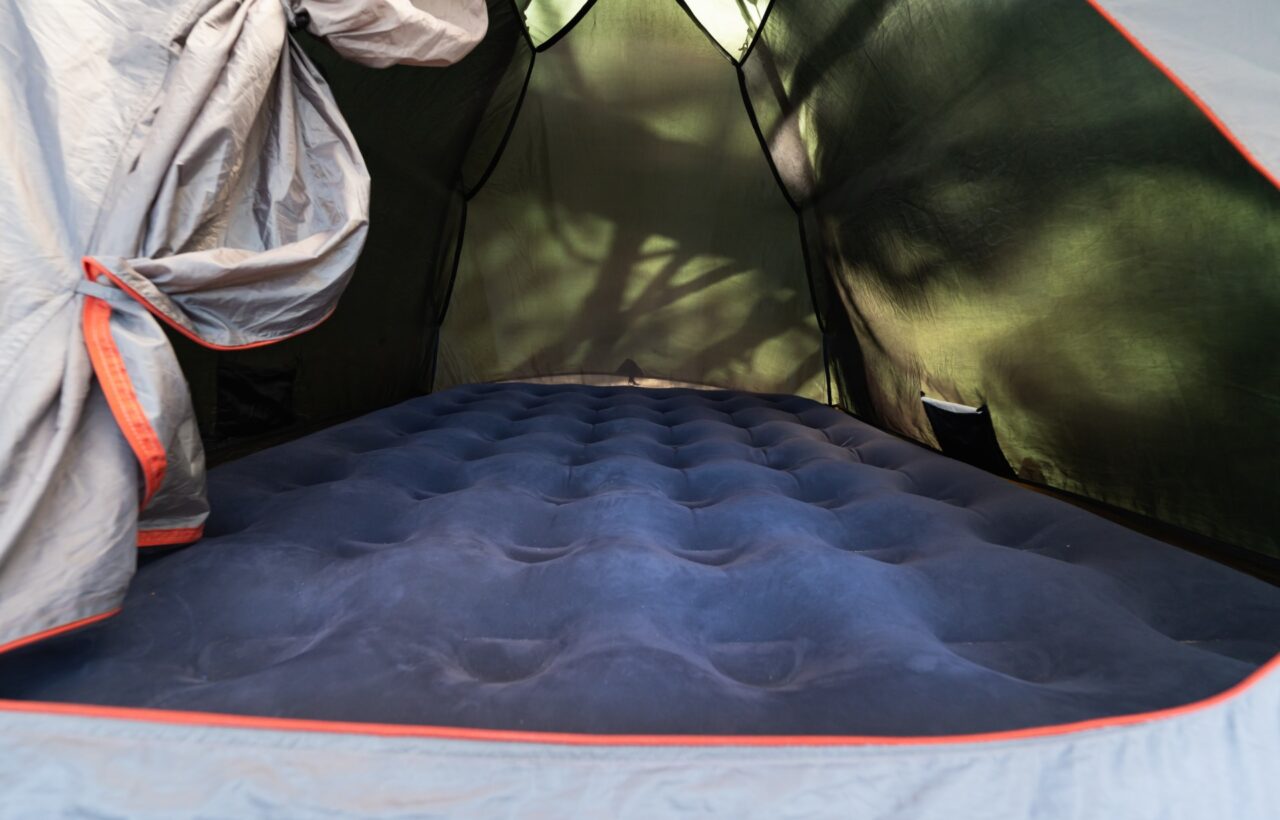
A tent camping bed is any sleep surface built for use inside a ground tent: a cot, air mattress, self-inflating mattress, or bunk system. The right one does two jobs at once. It keeps you off rocks, cold ground, and condensation, and it still leaves enough room to sit up, dress, and reach the door.
Most people shop by comfort first and discover the real constraint later. The bed has to fit the tent you already own, not the tent the listing assumes. Floor size, wall slope, peak height, and insulation matter more than brand names.
What “tent camping bed” actually means
Search results mix three different products:
- Beds for ground tents — cots, air beds, and foam-core mattresses you place inside a family or backpacking tent
- Cot-tent combos — a folding cot with a small tent built over it
- Truck bed tents — shelters that attach to a pickup bed
This article covers the first category. That is what most people mean when they search “tent camping beds”: how to sleep better inside a tent without buying a new vehicle or a rooftop tent.
A sleeping bag is insulation. A tent is weather protection. The bed is the missing third piece. If that layer is too thin, too tall, or uninsulated, the other two cannot save the night.
The four types of tent camping beds
Camping cots
A cot is fabric stretched over a folding frame. You sleep several inches off the floor.
Strengths: no pump, no overnight sag from cooling air, storage under the frame, easier on knees when getting up, less contact with a damp tent floor.
Limits: bulky in the car, firm unless you add a pad, and often too tall for small dome tents. Cold air can move under the fabric, so a cot is not automatically warmer.
Typical specs:
- Sleep surface: about 72–85 in long, 25–32 in wide
- Height: about 7 in (low-profile) to 16–18 in (standard)
- Capacity: commonly 250–450 lb; oversized models go higher
- Packed weight: often 7–20 lb for a single cot
Low-profile cots exist specifically for tents with sloping walls. If your tent peaks at 48 in or less, a 16-inch cot can leave almost no sitting room once you add a pillow and your torso.
Air mattresses
These are inflatable chambers, usually PVC or a more durable coated fabric. Guest-room “double high” models can sit 15–22 in tall. Camping-specific air beds are often lower.
Strengths: familiar, soft feel; easy to share a double or queen; packs smaller than most cots.
Limits: puncture risk on tent floors, poor insulation unless the mattress is rated, overnight softening as air cools, and height that pushes sleepers into tent walls.
A household air bed and a camping mattress are not the same product. Household PVC beds are built for carpet. Tent floors sit over grit, pine needles, and seams. A thin PVC bed often lasts a season or two of regular camping. Camping models use tougher fabrics and, when they are worth buying, publish an R-value.
Air also contracts as temperature drops. A mattress that felt firm at 8 p.m. can feel half-empty at 3 a.m. even with no leak. That is physics, not always a puncture.
Self-inflating and foam-core mattresses
These combine open-cell foam with an airtight shell. Open the valve, the foam expands and draws in air, then you top it off. Thickness is usually 2–4 in for quality car-camping models.
Strengths: far better insulation than a cheap air bed, more stable feel than a bag of air, less wobble than a tall raised mattress, and they stay usable even if they lose a little pressure.
Limits: heavier and bulkier than a rolled air bed; they never pack as small as a backpacking pad; they still need a clean, protected floor.
This category is what many experienced car campers actually mean when they say they “upgraded the mattress.” Models in this group often carry R-values of 4 to 8, which is the difference between a cold hip and a usable spring night.
Bunk cots and cot-tent hybrids
Bunk systems stack two cots in one footprint. Disc-O-Bed-style units are the common family option. Kid bunks are shorter and lighter; adult bunks are large and heavy.
Adult Disc-O-Bed Large outer size is about 82 × 32.5 × 36 in, with the top deck around 32 in off the floor. The 2XL version is taller still, about 46 in overall with the top cot near 40 in. Those numbers only work in a cabin-style tent with near-vertical walls and high peak height. They do not belong in a compact dome.
Cot-tent combos put a small shelter over a single cot. They keep you off wet ground and set up fast, but ventilation is often weak, condensation can collect on the low ceiling, and many beds are short for campers over 6 ft.
How the options compare
| Factor | Cot | Cheap air bed | Insulated camping mattress | Bunk cot |
|---|---|---|---|---|
| Feel | Firm, stable | Soft, can sag | Firm-plush, stable | Firm |
| Setup | Unfold and lock | Pump required | Valve + short top-off | More parts, no tools on good systems |
| Insulation | Needs a pad on top in cold | Usually poor | Built-in R-value | Same as a cot |
| Puncture risk | Low | High | Moderate | Low |
| Tent fit | Height is the limiter | Height and width | Width and packed bulk | Needs a tall cabin tent |
| Storage in tent | Under the frame | None | None | Under bottom cot |
| Best use | Multi-night car camp, sore knees | Warm-weather weekends | Three-season comfort | Families short on floor space |
No single type wins. The better question is which constraint you cannot ignore: packed size, tent height, cold ground, or two sleepers in one footprint.
Match the bed to the tent before you buy
Tent capacity labels are marketing, not floor plans. A “4-person” tent is sized for four sleeping bags, not a queen mattress plus two nightstands of gear.
Measure usable floor, not advertised capacity
Use the manufacturer’s interior floor length and width. Then subtract space the walls steal.
Dome and tunnel tents slope inward. At mattress height, you often lose 6–8 in from each dimension compared with the floor. Cabin tents with near-vertical walls waste less of that space.
Leave a gap around the bed:
- 4–6 in on each side if you only need to squeeze past
- 10–15 in if you want to sit, dress, or keep bags inside without pressing fabric against the wall
Fabric pressed to a wet fly wicks condensation onto bedding. That is one of the most common “the tent leaked” complaints that is not a leak.
Height is the measurement people skip
Add these numbers:
- Bed height (cot deck or inflated mattress)
- Your seated torso height, or at least 24–30 in if you want to sit up
- A few inches of clearance so your head does not rub the ceiling
A 45 cm (18 in) raised air bed in a tent with 120 cm (47 in) peak height leaves about 75 cm (30 in) above the mattress. That is enough to slouch, not enough to sit comfortably. Double-high guest mattresses belong in cabin tents, screen rooms, or large family tents, not compact domes.
Rule of thumb:
- Peak under 50 in: sleeping pad, low-profile cot (about 7–8 in), or a thin self-inflating mattress
- Peak 50–72 in: standard cot or 4–8 in camping mattress
- Peak 72 in and vertical walls: tall cots, raised air beds, adult bunk systems
Practical size pairings
These are starting points, not guarantees. Check your tent’s exact floor diagram.
- 2-person dome: one twin / regular pad or a narrow single cot. A full-size air bed usually fills the floor and touches the walls.
- 3-person tent: one full / double mattress or two narrow pads. A queen is a tight, wall-contact fit in most models.
- 4-person cabin or tunnel: one queen, two twins, or two standard cots if width allows.
- 6-person family tent: queen plus kids’ pads, or a bunk cot on one side and an adult mattress on the other — if peak height supports the bunk.
Inflate or assemble the bed at home and tape the outline on the floor. Then compare that rectangle to your tent’s published inner dimensions, not the rainfly footprint.
Warmth is a ground problem, not a blanket problem
You lose more heat downward than upward. A sleeping bag’s temperature rating assumes you have insulation underneath. The bed supplies that insulation, or it does not.
R-value measures resistance to heat flow through the sleep surface. Higher is warmer.
A working guide:
- R 1–2: warm nights only; typical cheap air bed
- R 2–4: summer into mild shoulder seasons
- R 4–6: most three-season tent camping
- R 6+: cold ground, late fall, winter
A thick air bed can still be a cold bed. Air circulates inside the chamber and carries heat to the cold floor. Foam cores and baffled insulated pads slow that transfer.
Cots interrupt ground contact, which helps on damp or rocky sites, but air moving under the fabric can chill you once nights drop into the 40s °F. The fix is a sleeping pad on top of the cot, not a thinner bag.
For an uninsulated air mattress on cold ground, insulation belongs under the mattress as well as in the bag. A closed-cell foam pad under a cheap air bed is a cheap upgrade that does more than buying a thicker uninsulated mattress.
Choose by trip type, not by catalog photos
Weekend car camping in warm weather
A standard air mattress or a mid-height cot both work. Prioritize packed size and setup speed. Bring a footprint under the tent and a patch kit if you choose air.
Shoulder-season or mountain nights
Buy insulation first. A self-inflating mattress around R 4–7, or a cot plus a pad, beats a taller “luxury” air bed with no R-value.
Families in one tent
Floor space is the scarce resource. Options that work:
- One wide duo mattress for adults, pads for kids
- Kid bunk cots so adults keep the floor
- Adult bunks only if the tent is a tall cabin model
Do not stack adult bunks in a tent that cannot clear the top sleeper’s sitting height. Kids’ bunks are shorter and are the version that actually fits many family tents.
Older knees, stiff backs, or getting up at night
Height helps. A standard cot or a moderately raised mattress reduces the deep squat required by a 2-inch pad. Firm support from a cot or foam-core mattress is often easier on a sore back than a mushy air bed that bottoms out at the hips.
Walk-in sites and small cars
Cots and queen air beds eat trunk space. A rolled self-inflating mattress or two compact pads usually win. If you need a cot, look at pack size, not just assembled comfort.
Fit, inflation and placement problems with tent beds
Buying the bed for a tent you do not own. Listings show beds in spacious cabin tents. Your Sundome is not that tent.
Using a double-high guest mattress in a sloped dome. The bed will bulge the walls, block vents, and collect condensation.
Treating “4-person” as “queen plus gear.” If bags have to live on the mattress, you will fight zippers all night.
Skipping a footprint. Most punctures come from below, through the tent floor.
Over-inflating. A rock-hard air bed is worse for hips and seams. Stop when there is slight give under a palm.
Assuming a cot is warm. Add a pad when nights are cold.
Putting the bed against the wall. Leave a gap so condensation stays on the fly, not on your sleeping bag.
Ignoring door swing. A cot that blocks the only door turns every bathroom trip into an obstacle course.
Forgetting packed size. A 60 lb bunk system is excellent in camp and miserable if it does not fit in the vehicle with the cooler.
How to set up a tent camping bed so it lasts
- Clear the site of rocks, cones, and sticks before the tent goes down.
- Use a footprint slightly smaller than the tent floor so rain does not collect under the edge.
- Pitch the tent fully and tension the walls before bringing the bed inside. Inflating a mattress outside and dragging it through the door is easier than assembling a wide cot in a cramped vestibule.
- Keep the bed off the walls.
- Store boots and wet layers in the vestibule, not on the sleep surface.
- In cold weather, pre-warm the bag and add the insulating layer the bed does not already provide.
- In the morning, dry the mattress and tent floor before packing. Foam-core beds packed wet grow mildew.
A small electric or battery pump is worth carrying for air beds. Lung inflation adds moisture inside the chamber and is a poor plan for anything larger than a backpacking pad.
What to look for on the spec sheet
Ignore adjectives like “luxury” and read these numbers:
- Assembled length and width, not “fits most tents”
- Height of the sleep surface
- Packed dimensions and weight
- Weight capacity with margin; ratings assume even load, not a person sitting on one corner
- R-value for any mattress that will see nights below about 50°F
- Frame material on cots: steel is heavier and stable; aluminum is lighter
- Fabric denier and coating on decks and mattress shells
- Repair policy or included patch kit
If a mattress has no R-value, treat it as summer-only unless you add a foam pad underneath.
Frequently asked questions
Is a cot or an air mattress better in a tent?
A cot is better when you want elevation, under-bed storage, and no pump. An air mattress or foam-core mattress is better when you want a softer shared surface and smaller packed size. Comfort is personal; tent height and insulation are not.
Will a queen air mattress fit in a 4-person tent?
Sometimes, if the tent is a cabin style with a wide, rectangular floor. In many 4-person domes, a queen fills the floor and touches sloped walls. Check inner width, not the person rating.
Do I still need a sleeping pad on a cot?
In warm weather, many people sleep on the cot fabric alone or with a thin pad for cushion. When nights are cool, yes. The cot lifts you off the ground but does not replace an R-rated pad.
Why does my air mattress go soft overnight?
Cooling air contracts. Top it off before bed and again if needed. If it is flat by morning every time, look for a leak at the valve, seams, and corners with soapy water.
Are tent-cot combo beds worth it?
They are useful for festivals, flooded ground, and solo car camping when you want one piece of gear. They are a poor substitute for a roomy family tent. Condensation and short bed length are the usual complaints.
What is the most durable option?
A steel-frame cot with a replaceable deck, used with a footprint, usually outlasts PVC air beds. Quality self-inflating mattresses sit in the middle: they can last years if stored dry and not folded across the same crease every trip.
The bed that works is the one that clears your tent walls, matches the coldest night you actually camp, and still leaves a path to the door. Measure the tent first. Choose the sleep surface second.