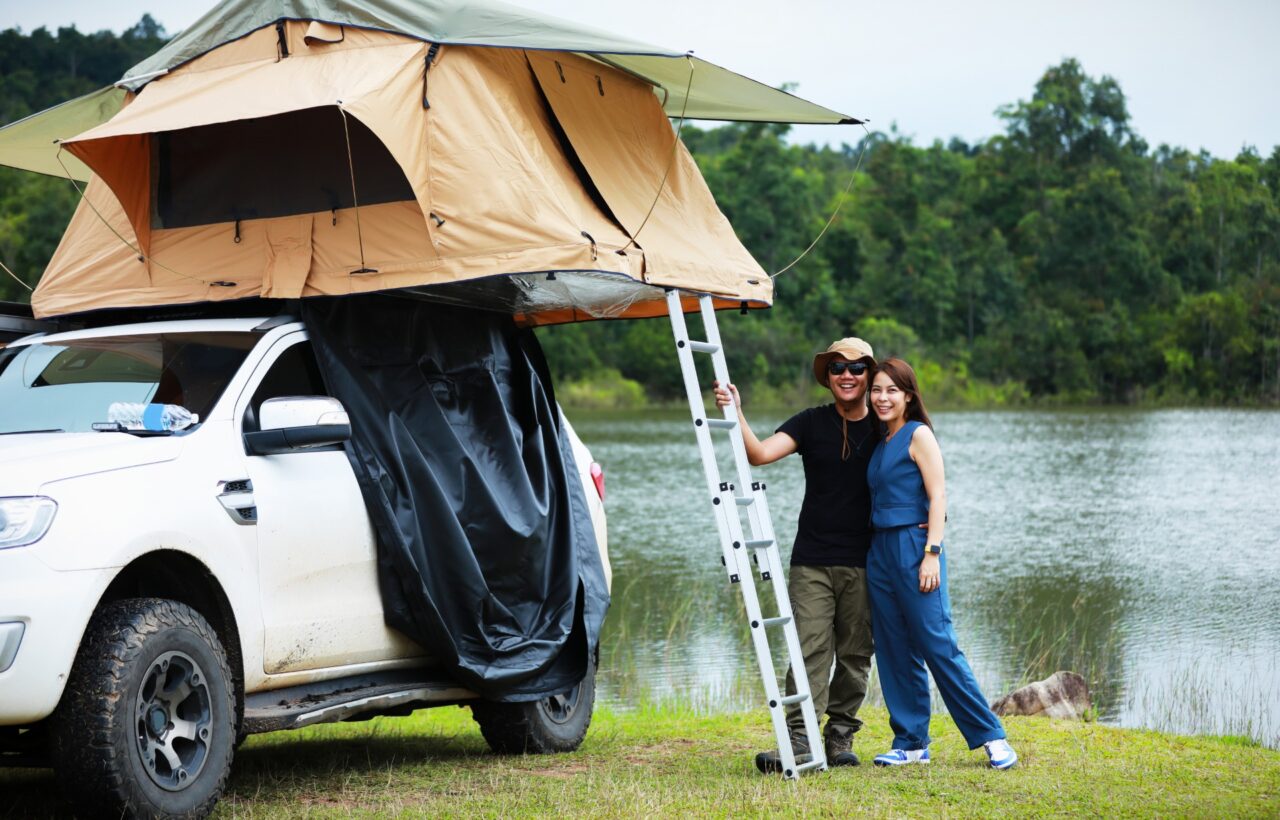

Tent box camping means sleeping in a folding tent that stays mounted on your car roof. You park, open the box, climb a ladder, and sleep on a fitted base a couple of metres off the ground. In the UK the phrase usually points to TentBox, a Southampton brand that has made this style of roof tent the default image of car camping since the mid-2010s, though the same idea exists across other roof-tent makers.
The appeal is speed and a dry floor. A ground tent still wins on price, porch space, and the freedom to leave the pitch and drive off. A tent box wins when the trip is a road loop, the ground is hard or wet, and you would rather not spend the first twenty minutes of every stop fighting poles.
What a tent box is, and what it is not
A tent box is a roof tent: a sleeping pod fixed to roof bars, packed into a low shell or cover for driving, and opened on site. Soft-shell models fold out like a book. Hard-shell models hinge open on gas struts. Most include a ladder. Most include some kind of sleeping surface, from tensioned fabric to a foam mattress.
It is not a campervan. Cooking, seating, and storage still happen at ground level, usually in the boot or under a small awning if you add one. It is also not a right to camp anywhere the car can park. The tent only solves the shelter. Permission, campsite rules, and overnight-parking restrictions still apply.
TentBox’s current range is five models, all rated by the maker for four-season use, with a stated internal load of 300 kg and a five-year warranty. UK list prices on the brand’s comparison page sit at about £999 for the GO, £1,349 for the Lite, £1,999 for the Lite XL, £2,199 for the Classic, and from £2,499 for the Cargo. Sale prices move, and European list prices are higher, so treat those figures as a snapshot rather than a quote.
Who tent box camping suits
It fits people who camp from the car and move often: weekend loops, festival-adjacent stops, coastal hops, Scotland road trips. Setup after the first fitting is measured in seconds to a few minutes, not in a pile of poles. You are off wet grass, mud, and most ground insects. Boot space stays free because the bedroom lives on the roof.
It is a poor fit if you want a basecamp. Once the tent is open, the car is the pitch. Drive off for a day walk and you either pack the tent down or leave the spot empty and hope it is still yours. Families of four only have one real option in this range, the Lite XL, and that model needs a roof that can carry 62 kg plus bars. Anyone whose car has a low dynamic roof limit, or only clamp-on door-jamb bars, should stop before looking at colours.
The vehicle check that matters more than the tent
A roof tent is legal on UK roads if it stays inside the vehicle and bar ratings, is fixed so it cannot shift, and does not block the driver’s view, lights, or number plate. Extra height is your problem at barriers, car parks, and low bridges, not a separate offence by itself.
Three limits decide whether a given car can carry one.
Dynamic roof load. This is the weight the roof may carry while the car is moving. It is in the handbook, often 50–100 kg depending on the model. The total that counts is bars, feet, mounting hardware, and the tent, plus anything left inside the shell on the road. The parked, occupied load is higher, but manufacturers do not publish one simple multiple of the driving limit. Do not invent one.
The bars, not just the roof. Crossbars with a rating at least as high as the loaded tent are required. Systems that clamp into the door jamb are a known mismatch: Thule and Yakima both say their rooftop tents should not be used on clamp or clip-style towers, because the static load of people inside can damage the rack or the car. Raised rails, fixed points, or a proper flush-rail fit kit are the usual safe starting points. TentBox and bar retailers both publish vehicle checkers; use them for the exact model year, not for “a Golf” or “a RAV4” in general.
Height and insurance. Closed heights in this range run from about 17 cm on the Cargo shell to 45 cm on the GO, before bars. Add that to the car and you will meet barriers that a bare roof clears. Some insurers treat a roof tent as a modification or accessory that must be declared. Failing to tell them can be the expensive mistake, not the tent.
Off sealed roads, vibration rises. Guidance from rack specialists is to cut the carried load, sometimes by around 30 percent, on rough tracks. A campsite gravel road is not the same thing as a green lane.
Soft-shell fold-out or hard-shell pop-up
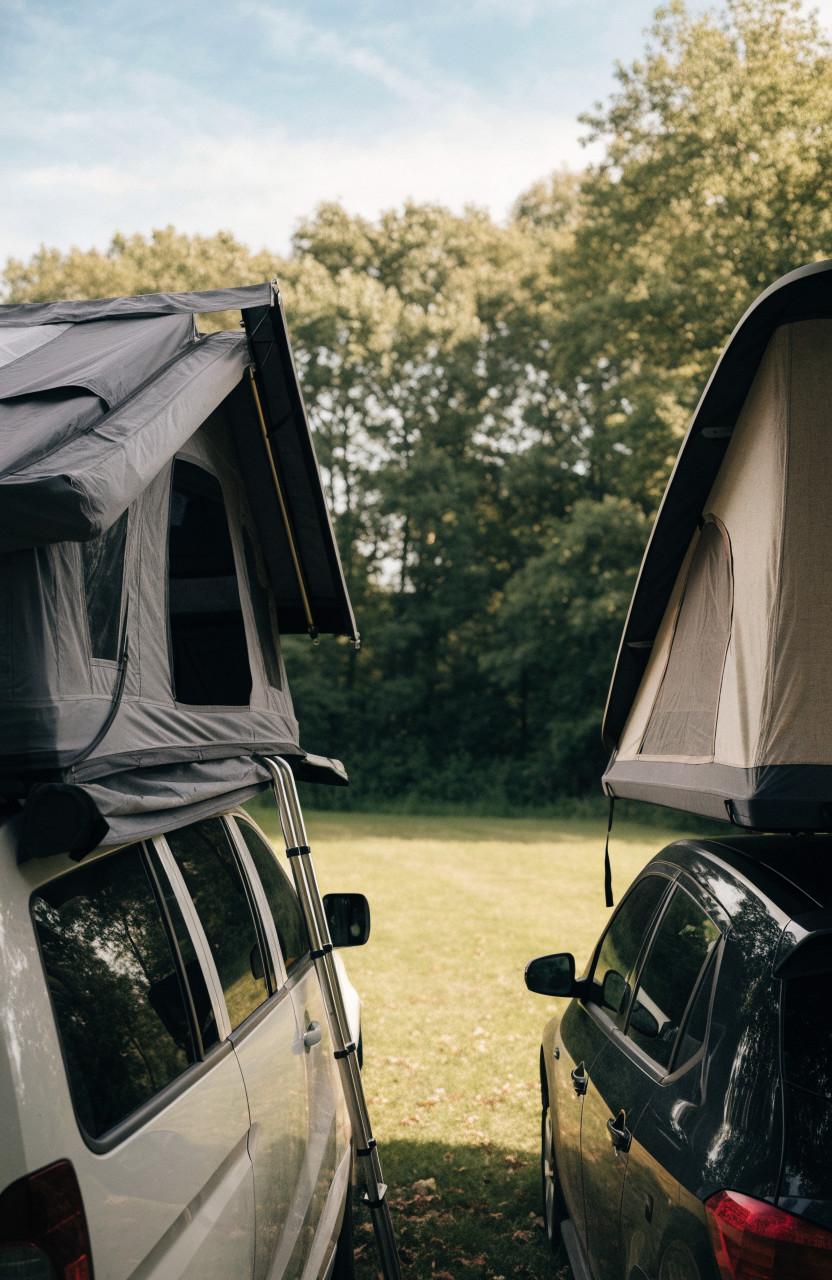
Soft-shell TentBox models (GO, Lite, Lite XL) pack flatter or lighter and cost less. The Lite closes to 25 cm high and about 50 kg, which is why it shows up on smaller cars. You unfold it with the ladder and poles. Bedding usually has to come out, or at least be managed, before the cover goes on. A soft travel cover also adds drag: reviewers consistently notice worse motorway economy and more wind noise, with less effect below about 50 mph.
Hard-shell models (Classic, Cargo) open on gas struts in about 30–60 seconds and let you leave the mattress and duvet inside. The shell is more aerodynamic when closed than a fabric cover, at the cost of weight: 67 kg for the Classic, 72 kg for the Cargo. The Cargo is the only one in the range that can carry gear on the closed lid. Both need a stronger roof and, practically, two people to lift on and off.
The GO is the outlier. At 33 kg it is the lightest, opens in about a minute, and sleeps on tensioned fabric rather than a foam mattress, closer to a camp bed than a bed. It is the model people fit when the roof limit is tight. It is also the one most often described as comfortable for one adult and snug for two.
How the TentBox models actually differ
| Model | Type | Weight | Sleeps | Opens in | Closed size (approx.) | UK list price (comparison page) | Best used when |
|---|---|---|---|---|---|---|---|
| GO | Soft, manual | 33 kg | 2 | 60 sec | 122 × 225 × 45 cm | £999 | The roof limit is low and you want the lightest option |
| Lite | Soft, fold-out | 50 kg | 2 | 5 min | 133 × 110 × 25 cm | £1,349 | You want a foam mattress and the smallest packed height |
| Lite XL | Soft, fold-out | 62 kg | 4 | 5 min | 183 × 120 × 25 cm | £1,999 | You need a family-sized floor and the car can carry it |
| Classic | Hard shell, gas struts | 67 kg | 2 | 60 sec | 128 × 218 × 35 cm | £2,199 | You will camp often and want bedding left inside |
| Cargo | Hard shell, gas struts | 72 kg | 2 | 30 sec | 130 × 215 × 17 cm | from £2,499 | You also need to carry bikes or a box on the lid |
Sleeping floors are the part the marketing photos hide. The Lite is about 130 × 220 cm, a double that two broad adults will find narrow. The Classic and Cargo are about 120 × 210 cm. The Lite XL is about 180 × 240 cm, which is why it can take four, though the stated 300 kg internal limit is the same as the two-person models, so four adults plus kit is the edge of the rating, not the middle. All quote a pod hydrostatic head of 3000 mm, with a 5000 mm rainfly or an impermeable shell on the hard-top models. Wind ratings on current brand pages go up to 50 mph; older spec sheets said 39 mph. Check the page for the unit you are buying, and still pick a sheltered pitch in a gale. A rating is not a promise about your local campsite in a named storm.
First fitting is not the same as nightly setup. Brand figures put installation at roughly 20 minutes for the Classic, 30 for the Lite models, 45 for the Cargo, and 60 for the GO. After that, nightly opening is the short number.
What a night actually involves
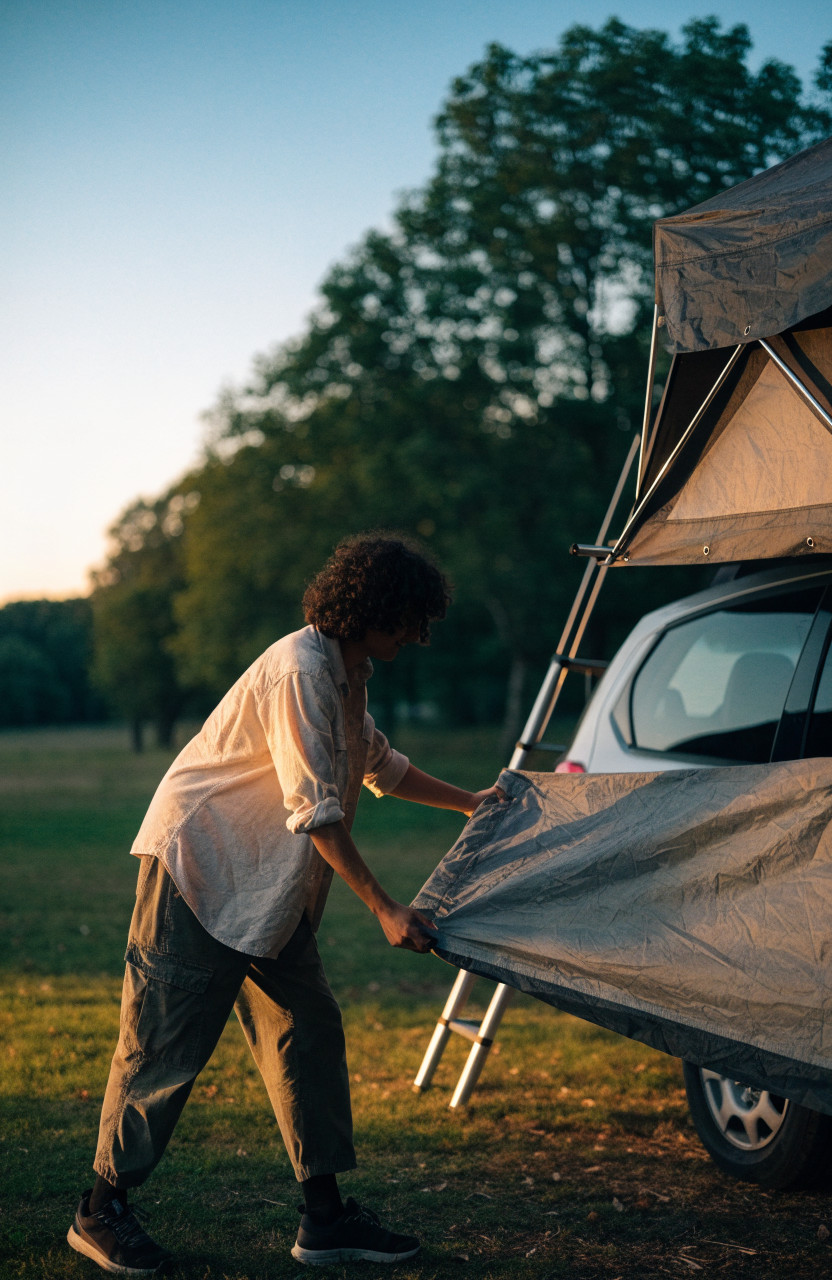
You arrive, check the spot is level enough that you will not roll toward the door, and open the tent. On a Lite that means removing the cover, deploying the ladder, pulling the base out, and tensioning the rainfly poles. On a Classic or Cargo it means releasing the shell and letting the struts do the lift, then fitting the ladder. Five minutes is a fair expectation once you have done it twice. The first time takes longer.
Inside, storage is pockets and a few straps, not a wardrobe. Shoes tend to come into the pod because there is no built-in porch on these models. Vent the windows. Roof tents hold warmth and also hold condensation if every vent stays shut, which is the usual first-night complaint, not a leak. A sleeping bag rated for the actual overnight temperature still matters. “Four season” describes the fabric and the design intent, not a heated room.
Packing down is the same sequence in reverse, with the extra rule that wet canvas should not be sealed for days. If you are moving every morning, a quick wipe and an open boot or a dry afternoon stop is enough. If the tent lives on the car all season, plan a proper dry-out at home.
Day trips are the operational catch. Pack the tent if you need the car. On a booked pitch, some people drop the shell, leave a chair, and accept the risk. There is no third option where the bedroom stays up and the car leaves.
Where you can use one
A campsite pitch is the straightforward case. You occupy a standard pitch: car plus shelter. Ask about height barriers and whether roof tents are treated as tents or as campervans for pricing. Most sites charge a pitch fee either way.
Off-site, the tent changes nothing about land law. In England and Wales you need the landowner’s permission, apart from specific arrangements such as Dartmoor’s current wild-camping rules. In Scotland, responsible access allows wild camping in many places, with exclusions and bylaws in pressured areas such as parts of Loch Lomond and the Trossachs. A lay-by or pub car park is not automatically available overnight. “Camp where you park” in roof-tent advertising means the ground does not have to take pegs. It does not mean the parking is legal.
What it costs beyond the box
The tent is the large line, not the only one. Suitable roof bars and a fit kit are often £150–400 if the car does not already have rated crossbars. Delivery is frequently included on UK orders; removal and winter storage are not. A 50–70 kg unit needs either a second person or a proper garage lift, and somewhere dry to live if you take it off.
Fuel is the running cost people under-budget. Any roof load adds drag. Soft covers are worse at motorway speeds than a hard shell. There is no single percentage that applies to every car. If most of your miles are above 60 mph with the tent left on, the hard-shell premium can be rational. If the tent comes off between trips, the cheaper soft-shell is usually the better spend.
Against a ground tent, a tent box is several times the price for less living space. Against a campervan, it is an order of magnitude cheaper and leaves you with a normal car on Monday. That is the real comparison, not “tent versus tent.”
Problems that show up after the first weekend
The fitting is the usual early snag. Bar spacing, torque on the mounts, and a second pair of hands matter more than the opening demo. A tent that shifts is a load that was never correctly clamped, not bad luck.
Condensation gets blamed on the fabric. It is mostly closed vents plus breath in a small volume. Crack a window even in light rain.
The ladder is fine for adults and older children. It is a poor bedroom access for toddlers who need the toilet at 2 a.m., and a poor idea in strong wind if you are carrying anything. Internal weight ratings around 300 kg sound generous until four people, a dog, and bags are added together.
Soft covers left on through winter collect dirt in the seams and hold damp. Hard shells still need the seals checked. Neither design removes the need to look at the mounts a few times a season.
Noise is the other quiet complaint. At motorway speeds a soft-shell cover can drone. A hard shell is quieter, not silent.
When to buy something else
Buy a ground tent if you camp a few nights a year, want a porch, or need to leave the pitch and walk. A decent family tent costs a fraction of a Lite and does not care what the roof is rated for.
Buy the hard shell if you will use the tent most fair-weather weekends and hate repacking bedding. Buy the Lite if the car is small and two people are the plan. Buy the Lite XL only after the roof-load maths works, not because four berths sounds useful. Buy the GO if weight is the constraint and you can live with a camp-bed floor. Skip the category if the only bars you can fit are door-jamb clamps, or if the handbook roof load cannot clear the tent plus bars with margin.
The decision is mostly the car. The tent is the easier part.
Questions people ask before buying
Does a tent box fit any car? No. It fits cars whose dynamic roof load clears the tent plus bars, with a bar system the tent maker and the rack maker both allow. Check the exact model year.
Can you leave bedding inside? On the Classic and Cargo, yes. On the fold-out Lite models, the design generally means bedding comes out or is tightly managed before the cover goes on. The GO’s fabric base stays in; a separate mattress is not the standard setup.
Is it warm in winter? The fabric is specified for four-season use and will keep rain out. Warmth still comes from your sleeping bag and mat. A roof tent has more airflow under the floor than a ground tent, which some people find colder, not warmer.
Will it wreck fuel economy? It will raise consumption, more so with a soft cover at motorway speeds. Below about 50 mph the difference is smaller. Taking it off between trips removes the penalty entirely.
Do you need to tell your insurer? Often yes. Ask. An undeclared roof load is a worse outcome than a small premium change.
Is wild camping allowed because you are off the ground? No. Access rules are about land and parking, not about pegs.