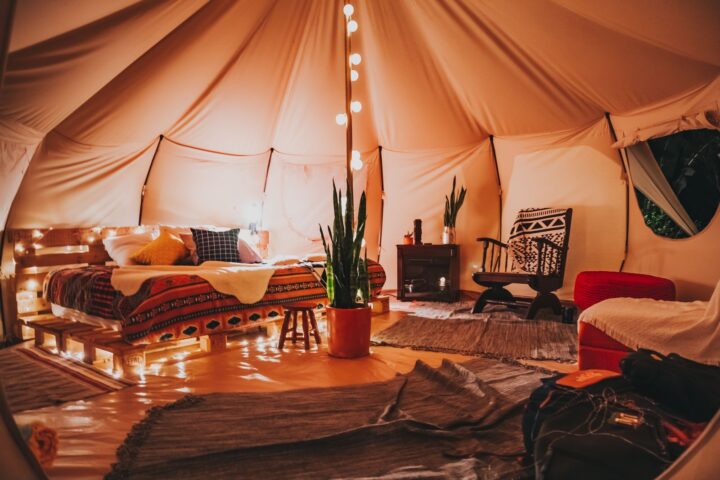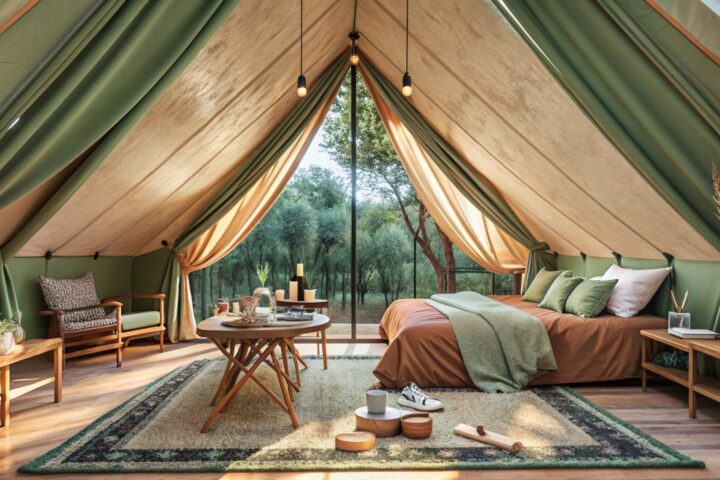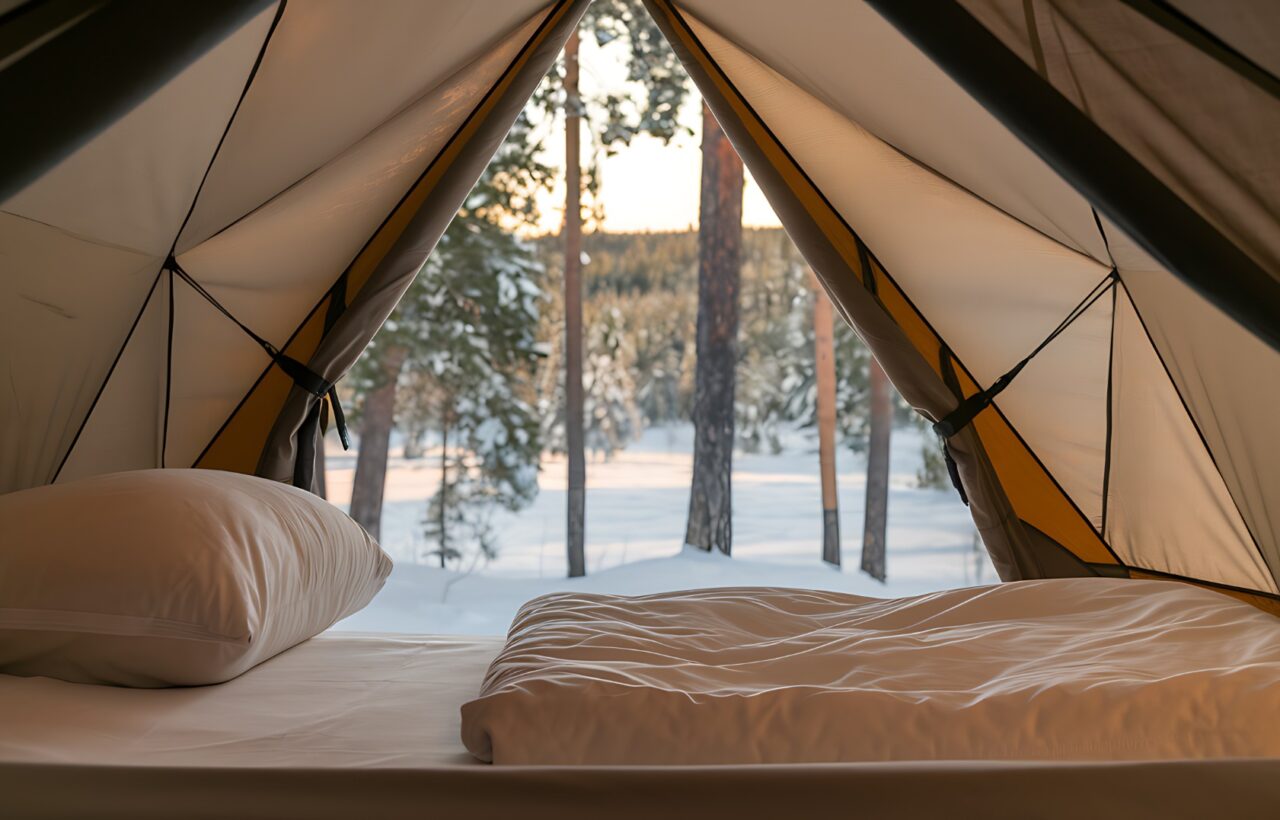
From the doorway, a bell tent looks spacious; add a real bed and it suddenly feels cramped. The canvas slopes, the center pole sits in the middle of the room, and the usable standing height lives in a ring around that pole. Good interiors work with that geometry instead of fighting it.
The ideas below cover layout, flooring, sleep, lighting, storage, heat, and setups for couples, families, and rental stays. Pick by tent size and how you use the space, not by a theme name.
How Bell Tent Shape Changes Interior Design
Most furniture advice is written for rectangular rooms. A bell tent is a cone with a short wall.
Typical specs vary by brand, but the pattern is consistent:
| Diameter | Approx. floor area | Center height | What usually fits |
|---|---|---|---|
| 3m (~10 ft) | ~75–80 sq ft | ~6.5–7 ft | One low double or two singles; little extra furniture |
| 4m (~13 ft) | ~125–135 sq ft | ~8–8.5 ft | One queen plus a small sitting or gear zone |
| 5m (~16 ft) | ~200–215 sq ft | ~9.5–10 ft | Queen plus kids’ beds or a real living corner |
| 6m (~20 ft) | ~280–300 sq ft | ~11–11.5 ft | Two living zones plus sleeping without crowding |
Side walls are often only 50–70 cm high. Tall headboards, high-back sofas, and full-height wardrobes waste the only standing room you have. Low furniture, perimeter beds, and rugs that define zones work better than “more stuff.”
The center pole is structural. Use the D-ring or hanging loop for lightweight lights or an inner tent. Do not hang heavy chandeliers, plants in ceramic pots, or loaded shelves from it.
Flooring Ideas
Bare PVC groundsheets feel cold, collect grit, and make the tent look unfinished. Flooring is the fastest upgrade.
1. Build a three-layer floor
Start with the factory groundsheet. Add a waterproof outdoor mat or interlocking foam tiles as a washable middle layer. Finish with a smaller rug in the sitting or sleeping zone. The middle layer takes the dirt; the top rug can stay nicer.
This also reduces the “cold from below” problem. Heat loss through the floor is one reason people wake up chilled even when the air feels fine.
2. Use a full-coverage outdoor rug, then a softer overlay
A recycled-plastic or polypropylene outdoor rug covers most of the circle and wipes clean. A jute, wool, or faux-sheepskin piece on top of that creates a sitting island. Full coverage hides the industrial look of PVC. The overlay is what guests actually notice.
Avoid thick indoor-only rugs as the only layer. They hold damp, take forever to dry, and can trap condensation against the groundsheet.
3. Add a dedicated shoe threshold
Place a tough doormat just inside the door and a shoe tray or crate beside it. Most tent mess starts at the entrance. If people kick off boots before they hit the nicer rug, the rest of the interior stays usable.
A second small mat outside the door keeps mud from walking in at all.
4. Raise the living floor with pallets or a low deck
For backyard or seasonal setups that stay in one place, a low pallet platform or interlocking deck tiles under the sitting area create a room-like feel and keep bedding off cold ground. Sand the edges and cover with a rug so nobody catches toes.
This is less practical for touring campers because of bulk. It is one of the best upgrades for a fixed glamping pitch.
Sleeping Layout Ideas
The bed is the visual center of almost every successful bell tent. Where you put it decides whether the space feels open or blocked.
5. Put the main bed opposite the door
Walking in and seeing a made bed reads as a room, not a campsite. Leave a clear path from the door around the pole. In a 4m tent this often means the bed sits in the back third, with the head toward the wall so you are not sitting up into canvas.
Low platform frames and low wooden bases work better than tall hotel frames. Ceiling height drops fast toward the wall.
6. Run family beds around the perimeter
When several people share a 5m or 6m tent, lining mattresses around the outer ring frees the middle for living space. Kids can still stand near the pole. Adults get wall-side storage behind the beds.
This layout also helps in wet weather: wet gear stays near the door instead of crossing every sleeping bag.
7. Raise the mattress on a cot or platform
A raised cot or low platform keeps you off cold ground, creates storage underneath, and makes getting in and out easier. Pair a quality mattress or thick topper with the frame. Airbeds alone often sag by morning and feel colder.
Leave the under-bed zone for closed bins, not loose clothes. Open clutter under a bed still looks like camping.
8. Use an inner tent as a bedroom
A half-moon inner tent hanging from the center pole creates a private sleeping pocket opposite the door. It also cuts drafts on faces, keeps bugs off bedding, and hides daytime mess.
Trade-off: you lose some of the open circular volume. Many families put the inner up at night and roll it back during the day if the fittings allow.
9. Make the bed look finished with layers, not just color
A fitted sheet, duvet or quilt, one textured throw, and two or three pillows is enough. Extra pillow mountains look good in photos and get in the way in a sloped tent. Choose washable covers if the tent is a rental or if kids and dogs share the space.
In cool weather, add a wool blanket you can pull up without changing the whole look.
Lighting Ideas
Lighting does more for atmosphere than almost any other decoration. Canvas already diffuses light; harsh white bulbs fight that.
10. Hang a light, low-wattage fixture from the center loop
Most center poles have a loop meant for an inner tent or a light. Use LED lanterns, a lightweight pendant, or a small battery chandelier. Keep the load modest. If the pole flexes or the peak puckers, the fixture is too heavy.
Warm white (around 2200–2700K) looks better on canvas than cool white.
11. Run a string of lights around the wall line
Lights at about head height, following the circle, make the tent feel larger than a single overhead source. Clip or loosely tie them to existing fabric loops. Do not puncture canvas with staples or nails.
Battery or USB strings are simpler than running mains cable across a damp floor.
12. Stack light at three heights
Combine one high source, mid-level lanterns on crates or tables, and a low path light near the door. The tent stops feeling like a cave after sunset, and you can turn layers off as people go to sleep.
Use LED candles instead of real flame. Canvas, bedding, and hanging textiles do not mix with open fire.
13. Keep task light separate from mood light
A small directional lantern or headlamp by the bed is for reading and packing. Mood lights stay dim. One bright overhead source makes everything look flat and keeps people from sleeping.
If you have site power, a dimmable lamp on a side table is more useful than another string of fairy lights.
Furniture and Zone Ideas
A bell tent works when it has two or three clear zones, not when every object is “pretty.”
14. Define zones with rugs, not walls
One rug under the bed, another under the sitting area, and bare or mat-covered floor at the door is enough. People read those surfaces as rooms. You do not need screens unless you need privacy.
In a 4m tent, commit to sleep + a tiny sitting pad. In a 5m or 6m, you can add a low table zone.
15. Choose low tables you can move
Wooden crates, folding camp tables, or a low coffee table work because they sit under the slope. A full dining table in a 4m tent usually blocks the only standing path.
Crates earn their space: they are a table, a seat, and storage.
16. Seat people on the floor on purpose
Poufs, floor cushions, and a thick rug handle guests better than four camping chairs inside a small bell. Chairs fight the wall height and crowd the pole. Keep one or two proper chairs if someone cannot sit low.
17. Build a door-side kitchen nook
Food, a cool box, washing-up, and bins belong near the entrance. That keeps smells, crumbs, and wet gear away from beds. A narrow folding unit or stacked crates is enough.
If you cook with gas, do it outside. Interior kitchens are for assembly, drinks, and storage.
18. Use a hanging fabric divider
A lightweight curtain from the center pole to one wall can split sleep from living without the bulk of an inner tent. Tie it back in the day. Choose a fabric that can get damp and still look acceptable.
This is useful for couples sharing with kids, or for a rental that needs a dressing corner.
Storage and Daily-Use Ideas
Clutter is what makes a styled tent collapse after one night.
19. Go vertical on the walls and pole
Use the existing inner loops for lightweight hanging organizers, a canvas pocket, or a small rail for robes. Keep weight distributed. Heavy items belong in floor bins, not swinging from canvas.
A hanging shoe organizer on the A-frame side of the door is more useful than it sounds.
20. Give every person one closed bin
Open baskets look styled until someone needs a sweater at 11 p.m. Lidded plastic or canvas bins slide under cots and stack by the wall. Label them if more than two people share the tent.
21. Add a small mirror opposite a window or door
A mirror bounces daylight, helps with dressing, and makes the circle feel less enclosed. Hang it low on a stand or lean it, rather than attaching hardware to canvas.
Avoid glass on a touring setup. Acrylic or a travel mirror is safer.
22. Hide cables and power
If you use a power bank, fan, or fairy lights, run cables along the wall seam or under the rug edge, never across the walking path. A small cable pouch by the pole keeps the look tidy and stops people tripping at night.
Heat, Season, and Atmosphere Ideas
Comfort in a bell tent is mostly insulation, ventilation, and textiles. Decoration comes after that.
23. Treat the stove as furniture only if the tent is built for it
A wood stove changes the whole interior: hearth mat, clearance from canvas and bedding, flue through a proper stove jack and flashing kit, spark arrestor, ventilation high and low, and a carbon monoxide alarm. Many manufacturers advise letting the fire die down before sleep rather than leaving it roaring overnight.
Do not improvise a pipe through ordinary canvas. Do not use unvented propane heaters as a “cozy fireplace.” They add moisture and carbon monoxide risk.
If you do not have a stove jack tent, use better bedding, a raised sleep system, and a hot-water bottle instead of forcing a fire feature.
24. Swap textiles by season instead of buying a new theme
Summer: lighter rugs, cotton bedding, more mesh and fewer throws. Shoulder season: wool blanket, thicker rug, warmer light. Winter: insulated sleep pad under the mattress, flannel or heavy duvet, draft control at the door, and extra ventilation so condensation does not rain on the bed.
The same furniture can serve all three if the textiles change. That is cheaper and easier to pack than a full restyle.
25. Build a rental- or guest-ready kit
If other people use the tent, choose washable rugs, spare fitted sheets, a laundry bag, a broom, a doormat, blackout eye masks or an inner, and lighting that guests can operate without instructions. Photograph the finished layout so you can reset it quickly.
Guest tents fail when they are styled for photos and impractical at 2 a.m. The reset should take minutes, not a full redesign.
What to Buy First, Depending on Your Tent
3m tent: mattress or thick pads, one good rug, warm lighting, shoe mat. Skip the sofa.
4m tent: one proper bed, layered floor, two crates, lights at two heights, closed storage.
5m tent: bed plus a sitting rug, low table, possible inner tent, real storage plan.
6m tent: two distinct zones, extra seating, and enough empty floor that people can walk around the pole without shuffling sideways.
If the budget is tight, spend it on sleep and floor first. Lighting is the next best change. Decorative objects come last.
Bell Tent Layout Fixes for a Better Room
The table below covers the layout choices that make a round bell tent feel smaller, damper or less restful.
| What you notice | Why it happens | What to do |
|---|---|---|
| No room to move around | A table or stove jammed against the center pole | Keep the center clear so there is a circulation path around the pole. |
| Hitting canvas and a cramped feel | Tall furniture placed against the sloping wall | Keep tall furniture away from the walls. |
| Fire risk and sagging peak fabric | Real candles plus too many lights hung from the peak | Skip real candles and avoid overloading the hanging lights. |
| Musty, stained or mildewed textiles | Indoor-only textiles laid on a damp floor or packed wet | Keep indoor-only textiles off damp floors and never pack them wet. |
| Decor that reads as leftovers | Mixing boho rugs, ski-chalet faux fur and rainbow pillows at once | Stick to one theme so the room looks like a plan. |
| Moisture building inside the canvas | Bodies, wet clothes and cooking produce moisture even in breathable canvas | Vent high and low, dry wet gear outside and never store the tent damp. |
| Bed annoying to get into | Copying Instagram layouts with a dozen pillows on the bed | Style the bed for nightly use, not the photo, so there are no 12 pillows to move. |
Frequently Asked Questions
What size bell tent do you need for a queen bed and sitting space? A 4m tent can take a queen if the frame is low and extra furniture stays minimal. A 5m tent is the more comfortable answer if you want a chair, table, or kids’ mattress without living in the aisle.
Can you put a normal bed frame in a bell tent? Yes, if it is low and you accept that the head of the bed sits under a slope. Measure wall height and mattress height together. Many people do better with a platform, cot, or slat base than a tall boxed frame.
How do you keep a bell tent interior clean? Shoe rule at the door, a washable base rug, lidded storage, and a small broom. Most dirt is tracked in, not generated inside.
Are fairy lights safe in a canvas tent? LED battery or low-voltage strings are the usual choice. Keep connections off wet floors, do not pinch cables in zippers, and avoid hot incandescent bulbs against fabric.
Do you need an inner tent? No. It helps with privacy, bugs, drafts, and visual clutter. It also shrinks the open volume. Couples who like the full circle often skip it. Families and cold-weather campers use it more.
What if the tent is only used in the backyard? You can go heavier: real mattress, larger rugs, a low sofa, even a small deck. You still need ventilation, a dry pack-down routine, and a plan for wind on the guy lines.
A bell tent interior works when every object earns its footprint. Start with floor, bed, light, and a clear path around the pole. The rest is optional.